
If you live in Naples, you already know the vibe. Big light, open sightlines, a kitchen that’s basically the social center of the house. People drift in with coffee. Friends perch with a glass of wine. Someone is always leaning on the counter even when you literally have a living room.
And that’s why kitchen islands matter so much here. But also why they go wrong.
Because the island looks amazing in a showroom photo, and then in real life it feels like you’re trying to squeeze past it with a tray of food while the dishwasher is open. Or it’s huge, sure, but nobody can sit comfortably without knees hitting cabinetry. Or the cooktop is on the island and now your whole main space smells like last night’s fish. Stuff like that.
So this is the real, practical guide. The island sizes that actually work in actual Naples homes. Not theoretical. Not Pinterest fantasy. Real walking paths, real seating, real appliances, real life.
A quick note before we talk inches
You don’t start with “I want a 10 foot island.” You start with:
- how many people actually use the kitchen at once
- whether you want seating (and how many seats you truly need)
- whether the island is prep only, or also sink, cooktop, microwave, beverage fridge, all of it
- and the big one, the thing that decides everything: clearance space around the island
In Naples, a lot of homes are open concept, and kitchens often face the living area or lanai. That open feel is the whole point. So the island can’t choke the room.
The one rule that never changes: clearance
Here’s the range that works in real remodels:
Minimum clearance around an island: 36 inches
Comfortable clearance: 42 inches
Two cooks, busy kitchen, appliance-heavy: 48 inches
And if you have seating on one side, that changes the math. Because you’re not just walking behind stools, you’re walking behind people sitting in stools.
Behind seated stools: aim for 48 inches, minimum 42 inches
This is usually where Naples kitchens either shine or fall apart. The island isn’t the problem. The space around it is.
If you want a clean open flow, design your island around the clearances first, then pick the island size that fits.
Common Naples layout patterns (and what islands fit them)
Naples homes are all over the map, but I see a few repeats.
1) Open concept great room kitchens
These can handle larger islands, but only if the work aisle still feels calm. You don’t want the island to become a wall.
2) Condo kitchens (Pelican Bay style, Park Shore, etc)
Often narrower. Islands can work, but usually as slimmer “work tables” or small seating bars. A giant 4 seat island is usually… not happening.
3) Older homes with compartmentalized kitchens
Sometimes you knock walls down and gain space. Sometimes you can’t. In these, islands need to be sized for traffic and door swings. People forget door swings.
Standard island sizes that actually work (with real use cases)
Let’s talk numbers. These are the sizes that consistently work well, depending on the goal.
Small but legit: 24 to 30 inches deep x 48 to 60 inches long
This is the “don’t force it” island. Great for condos, smaller kitchens, or when you mainly want extra prep space.
- Depth: 24 inches (30 if you want more landing space)
- Length: 4 to 5 feet
Seating? Sometimes 1 or 2 stools if you do an overhang, but it’s tight. This is more of a working island.
Best for: prep, serving, a place to drop groceries, maybe a microwave drawer if you plan it right.
The sweet spot for most Naples remodels: 36 inches deep x 72 inches long
If you’re doing a full kitchen remodel in a typical Naples single family home, this is a common “it just works” size.
- Depth: 36 inches gives you real workspace
- Length: 72 inches (6 feet) gives you room for zones
Seating: usually 2 stools comfortably, sometimes 3 if you’re okay with tighter spacing.
This is the island size where you can do:
- prep zone + seating zone
- or sink + prep + seating, if planned well
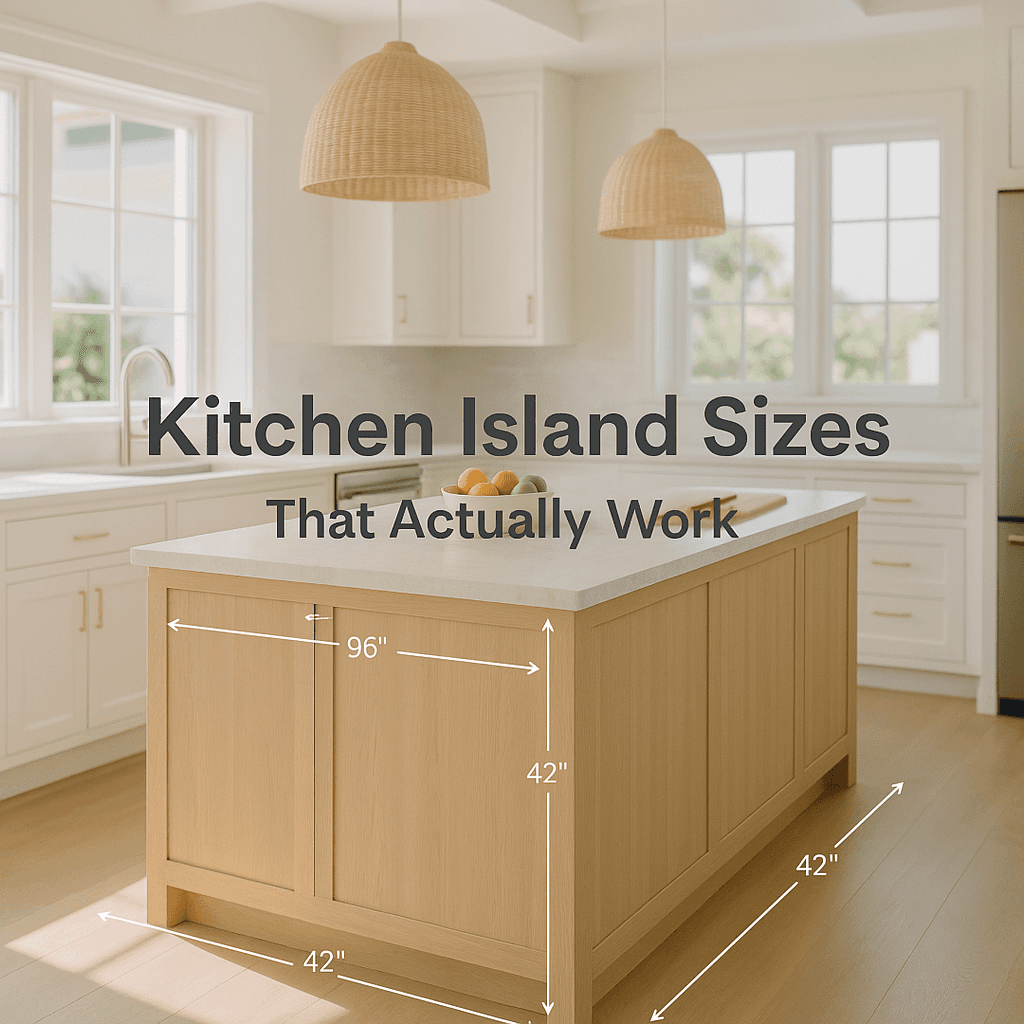
Entertainer island: 42 inches deep x 84 to 96 inches long
Now we’re talking the Naples “hosting” kitchen. Big island, big impact, but still needs the room to support it.
- Depth: 42 inches feels generous, especially for prep
- Length: 7 to 8 feet is where it starts to feel like a true gathering spot
Seating: 3 to 4 stools, comfortably, with proper overhang and spacing.
And yes, you can make it longer. But longer isn’t always better. Past 9 feet, it can start to look like a runway unless the room is scaled for it.
Oversized statement island: 48 inches deep x 108 inches long (or more)
This works in larger custom homes, or big open great rooms where the island is basically the anchor of the whole space.
But here’s the thing. If you’re putting a 10 foot island in, you should be planning:
- lighting scale (bigger pendants or more of them)
- long countertop seam planning (especially if stone is bookmatched)
- outlets, code, and where people will actually plug stuff in
- how you’ll clean it and live with it daily
Also, a giant island without a purpose can feel… weird. Like a hotel lobby table.
Best for: serious entertaining, large families, and homes where the kitchen is truly the main hangout zone.
Seating math (the part everyone argues about)
A lot of homeowners say “we want seating for 5.”
And then they never use 5 seats at once. Or they do, but it’s cramped and nobody is happy.
Use this as a realistic guide:
- 24 inches of width per stool is the minimum
- 26 to 30 inches per stool is comfortable
- Leave space at the ends too, so people aren’t sitting on the corner
So:
- 2 stools = 48 to 60 inches of seating run
- 3 stools = 72 to 90 inches
- 4 stools = 96 to 120 inches
And don’t forget overhang:
- 15 inches overhang is a common minimum for knees
- 18 inches feels more comfortable
- If you’re doing raised bar seating (less common now), the requirements change
Should you put a sink in the island in Naples?
Sometimes yes. Sometimes no. It depends on how you live.
Island sink works well if:
- you prep a lot and want to face the room
- your perimeter counters are already packed with windows or cabinetry
- you want the island to function as a true work zone
Island sink is annoying if:
- you hate seeing dishes or clutter in the middle of the kitchen
- you entertain a lot and want the island to be a clean serving surface
- you don’t want plumbing complexity (especially in condos)
A popular compromise in Naples remodels is a prep sink on the island (small, discreet) and the main sink on the perimeter. It keeps the island functional without making it the dish zone.
Cooktops on islands, honestly?
This is where I’m blunt. I’m not saying never.
But in Naples open concept homes, island cooktops tend to create two issues:
- ventilation problems
- splatter and grease where people sit and hang out
Downdrafts are better than they used to be, but they’re still not magic.
If you love the idea of facing the room while cooking, fine. Just be ready to invest in the ventilation and accept the reality of cleaning. If you want the island to be the social hub, a cooktop right there can mess with that.
The “walking path” mistakes I see all the time
1) Not accounting for appliance doors
Dishwasher open. Oven open. Fridge open. Suddenly your 42 inch aisle feels like 12 inches.
2) Making the island too deep
A super deep island looks impressive, but if you can’t reach the center comfortably, it becomes a clutter collector. Also, people don’t like sitting too far from the edge. It feels like a conference table.
3) Forcing seating when the room can’t handle it
Two stools used daily beats four stools nobody uses because it’s tight and awkward.
A simple island sizing cheat sheet
If you want the quick version:
- Best minimum functional island: 24 to 30 inches deep x 48 inches long
- Most balanced everyday island: 36 inches deep x 72 inches long
- Best for 3 to 4 seats: 42 inches deep x 84 to 96 inches long
- Big custom home statement: 48 inches deep x 108 inches long (with proper clearances)
And clearance:
- 36 inches minimum
- 42 inches better
- 48 inches ideal in busy zones or behind seating
Images (helpful visual references)
Here are a few solid visuals to ground the sizing ideas. These are example images, not tied to a specific product.
Typical island clearance diagram
Modern Naples style open kitchen with seating

Large island in a bright coastal kitchen
The easiest way to get your island size right (without guessing)
This is what I recommend, especially if you’re investing in a high end remodel.
- Put the island footprint on the floor with painter’s tape
- Add extra tape lines for clearance zones (36, 42, 48 inches)
- Open the fridge, dishwasher, and any oven doors into that taped space
- Stand where stools would go and imagine people actually sitting there
- Walk through with a laundry basket or a big serving tray, seriously
It sounds a little silly. But it saves you from the “we should’ve made it smaller” regret.
If you’re remodeling in Naples and want it sized right the first time
If you want a kitchen island that fits your actual space, not just a trend, it helps to work with a team that designs and builds this stuff every day in Naples homes.
Cutting Edge Builds does full kitchen remodeling locally, and you can see the service details and request a consultation here:
https://kitchen-remodeling-naples-fl.com/
Even if you already have a rough plan, it’s worth sanity-checking the island dimensions, clearance, seating, and appliance layout before anything gets ordered or framed.
Because once the island is built, it’s kind of… there. For a long time.
Final thought
In Naples, the island usually becomes the center of the house. Which is great. But only if it’s sized for how you move, how you cook, how you host, and how your kitchen actually flows on a normal Tuesday.
Bigger can be amazing. Smaller can be smarter. The win is when it feels effortless, like it always belonged there.
FAQs (Frequently Asked Questions)
Why is clearance space around a kitchen island crucial in Naples homes?
Clearance space is essential to maintain the open, airy vibe that Naples homes are known for. It ensures comfortable movement around the island, prevents congestion especially when carrying trays or when appliances like dishwashers are open, and accommodates seating behind stools. Recommended clearances are a minimum of 36 inches, with 42 inches being comfortable and 48 inches ideal for busy kitchens or two cooks.
What factors should I consider before deciding on the size of my kitchen island?
Start by assessing how many people use the kitchen simultaneously, whether you want seating and how many seats you need, the island’s function (prep only or including sink, cooktop, microwave, beverage fridge), and most importantly, the clearance space around the island to maintain open flow in your Naples home.
What are common kitchen island sizes that work well in Naples remodels?
There are several standard sizes: Small but functional islands at 24-30 inches deep by 48-60 inches long; the sweet spot for most remodels at 36 inches deep by 72 inches long offering workspace plus seating; entertainer islands at 42 inches deep by 84-96 inches long for larger gatherings; and oversized statement islands at 48 inches deep by 108 inches or more suited for large custom homes.
How do different Naples home layouts affect kitchen island design?
Open concept great room kitchens can accommodate larger islands if clearance is maintained. Condo kitchens tend to be narrower, favoring slimmer work tables or small seating bars rather than large islands. Older homes with compartmentalized kitchens require careful sizing to account for traffic flow and door swings when adding an island.
Can I have a cooktop on my kitchen island without affecting the rest of my living space?
Placing a cooktop on the island can cause cooking smells to permeate the main living areas, which may not be desirable in open-concept Naples homes. Proper ventilation planning is necessary to avoid lingering odors like fish from spreading throughout your home.
What should I keep in mind when planning lighting and other features for a large kitchen island?
For oversized islands (around 10 feet or longer), plan lighting scale carefully with bigger pendants or multiple fixtures. Consider countertop seam placement especially if using bookmatched stone. Ensure adequate electrical outlets placed conveniently for appliances and devices. Also think about daily cleaning and maintenance to keep your large island functional and welcoming.