
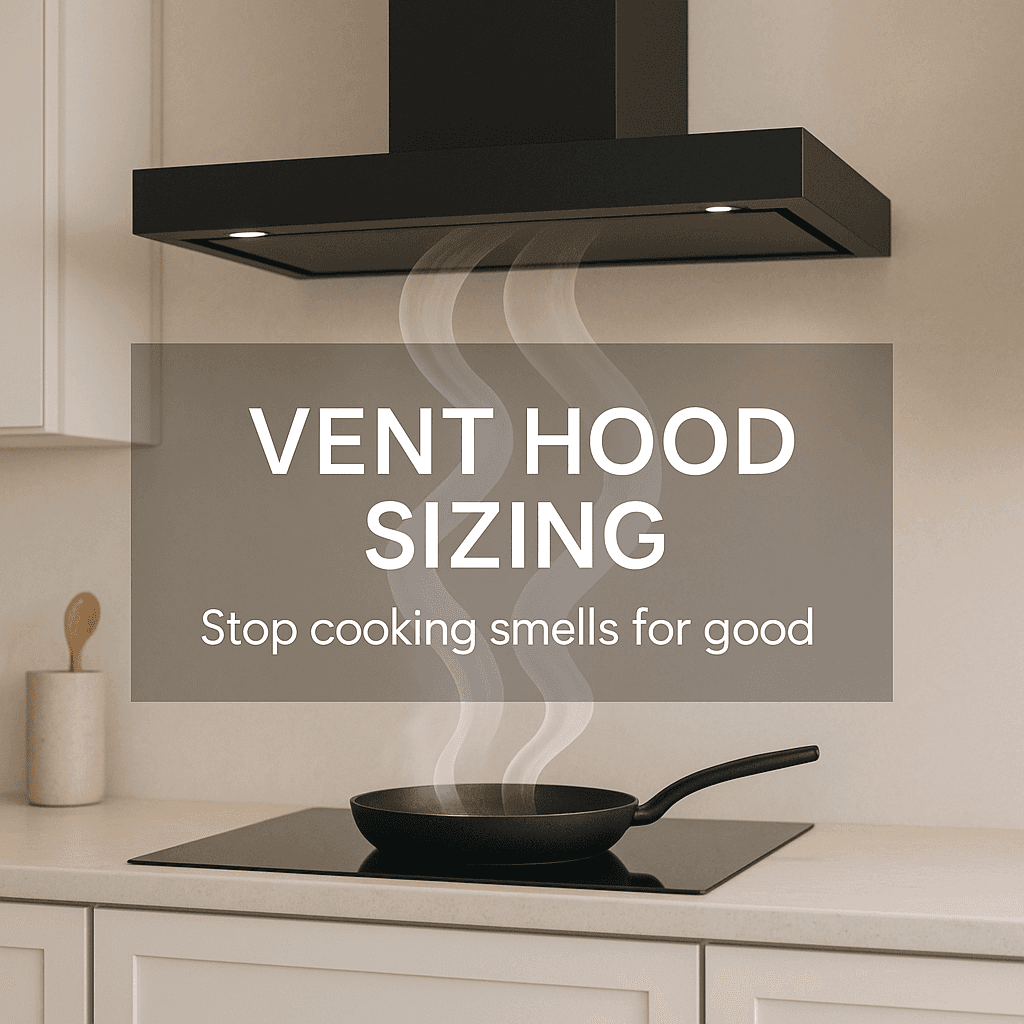
If your kitchen smells like last night’s salmon… this morning… and kind of still tomorrow, it’s not because you “cook a lot.”
It’s usually because your vent hood is undersized. Or the duct run is a mess. Or the hood is technically on, but it’s not actually capturing anything except your patience.
And yeah, lighting a candle helps. For about eight minutes.
Vent hood sizing sounds like one of those boring checklist items in a remodel. Until you live with a bad one. Then it becomes the thing you complain about every single time you sear steak, fry anything, or even boil pasta and watch steam roll across your cabinets.
So let’s fix it. Not with vibes. With numbers. And with real world stuff that actually changes performance.
Why “good enough” ventilation never feels good enough
A vent hood has one job: capture the smoke, steam, grease, and odor at the source and throw it outside.
When it’s the wrong size, a few things happen:
- It can’t keep up, so odors spread into adjoining rooms. Especially open concept layouts.
- Grease doesn’t get pulled in, it floats up and lands on cabinets, walls, and ceiling paint.
- Your AC works harder because you’re dumping heat and humidity into the house.
- You stop using the hood because it’s loud, and then everything gets worse.
That last one is big. An undersized hood often runs at higher speed all the time, which means more noise. People hate noisy hoods. So they avoid using them. And now the kitchen smells are basically a permanent roommate.
Vent hood sizing 101 (the simple math)
There are two common ways pros size a hood. Both matter, and the best answer is usually… a mix of both.
1) Size by cooktop width (capture area)
This is the part people can actually see.
- Hood width should be at least as wide as your cooktop.
- Better: go 3 inches wider on each side if you can.
So:
- 30 inch range? Aim for 36 inch hood
- 36 inch range? Aim for 42 inch hood
- 48 inch range? Aim for 54 inch hood (when space allows)
Why? Because smoke doesn’t rise in a neat straight line. It rolls, it drifts, it hits air currents. A wider hood gives you a larger “net.”
Also, depth matters too. Many builder grade hoods are shallow. They look fine. They don’t catch much.
- If you do a lot of high heat cooking, a deeper hood (or a hood with a good capture chamber design) makes a noticeable difference.
2) Size by airflow (CFM)
CFM means cubic feet per minute. Basically how much air the hood can move.
The rough rules you’ll see most often:
- Electric cooktop: 100 CFM per linear foot of cooktop width
- Gas cooktop: 100 to 150 CFM per linear foot (sometimes more)
Quick example:
A 36 inch cooktop is 3 feet wide.
- Electric: about 300 CFM
- Gas: about 300 to 450 CFM
But here’s where it gets real. If you have a strong gas range, or you actually use it like a gas range, those numbers can be too low.
If you have a gas range, use the BTU method too
This is the one that stops the “my hood is on but my eyes are still burning” problem.
A common guideline:
- CFM = total BTU output ÷ 100 (for typical residential setups)
So if your range outputs 60,000 BTU total, you’d look at around:
- 60,000 ÷ 100 = 600 CFM
If you’re shopping pro style ranges, totals like 70,000 to 120,000 BTU are not unusual. And that’s exactly when people install a decorative hood that “looks right” but performs like a bathroom fan.
And then they wonder why the house smells like garlic for two days.
The part everyone ignores: ducting can ruin a perfectly sized hood
You can buy a great hood and still get disappointing results if the duct design is wrong.
Here’s the short list of what matters:
Use the right duct size
Many higher CFM hoods require 8 inch or 10 inch ducting. If someone reduces that to 6 inch because it’s easier, the hood can’t breathe.
It’s like putting a straw on a shop vac.
Keep the duct run short and smooth
Every turn adds resistance. Every extra foot adds resistance. Flexible ducting adds a lot of resistance.
Ideal:
- Short run
- Smooth rigid metal duct
- Minimal elbows
- Proper exterior termination
Vent to the outside. Always.
Recirculating hoods (the ones that filter and blow air back into the room) are a last resort. They can help with some odor, but they don’t remove heat and humidity well, and they don’t truly solve grease in the air.
If your goal is “stop cooking smells for good,” you want exterior venting.
Make up air: the thing that becomes mandatory right when you need it most
If you go up into the 600+ CFM range, you might need make up air depending on local code and how tight your home is.
Make up air is simply a controlled way to bring fresh air in, so the hood can exhaust air out without:
- backdrafting combustion appliances
- causing doors to slam shut
- pulling humid air through weird gaps
- making your hood underperform
Even if code doesn’t force it, performance sometimes does. I’ve seen big hoods that feel weak because the house is so sealed up the hood can’t actually move the air it’s rated for.
This is one of those “talk to a pro during design” items, not after the drywall is done.
Common vent hood sizing mistakes (that look fine on day one)
Mistake 1: Matching hood width exactly to the cooktop
It works on paper. It undercaptures in real life. Going wider usually helps more than people expect.
Mistake 2: Buying based on CFM alone
A hood can have high CFM and still perform poorly if the capture area is shallow or the filters are cheap. Capture design matters.
Mistake 3: Too many elbows in the duct run
A couple turns happens. But if you’ve got a duct doing gymnastics through soffits and framing, you’ll lose performance fast.
Mistake 4: Ignoring hood mounting height
Mount it too high, you lose capture. Mount it too low, you bonk your head and hate cooking.
Typical ranges:
- Electric: often 24 to 30 inches above cooktop
- Gas: often 27 to 36 inches above cooktop
Check the hood manufacturer specs. Don’t guess.
Mistake 5: Choosing “quiet” by choosing “weak”
A hood that’s quiet because it’s not moving enough air is… not quiet. It’s just ineffective.
Better goal: a properly sized hood that runs on lower speeds most of the time, so it stays quieter naturally.
A practical sizing cheat sheet (not perfect, but close)
Here’s a simple starting point. You can adjust up if you do heavy cooking, high BTU gas, wok cooking, or lots of frying.
30 inch cooktop/range
- Hood width: 36 inches
- CFM: 300 to 450 (gas often closer to 400+)
36 inch cooktop/range
- Hood width: 42 inches
- CFM: 450 to 750 depending on BTU and cooking style
48 inch pro range
- Hood width: 54 inches if possible
- CFM: 900 to 1200 is common, sometimes more, and make up air becomes a real conversation
And remember. If your ducting is undersized or long, you may need to size up to compensate. Or better, redesign the ducting so you don’t have to brute force it.
What about Naples, FL homes specifically?
In Naples, a lot of kitchens are open concept, and a lot of homes are built to feel airy… but they can still be pretty tight from an HVAC and envelope standpoint. Plus humidity is always lurking, so exhausting steam properly actually matters. Not just for smell, but for comfort.
Also, if you’re doing a high end remodel, you’re probably upgrading appliances. That’s where ventilation gets missed. People spend on a gorgeous range, beautiful cabinets, perfect counters… then slap in a hood that can’t keep up. And the kitchen never feels as clean as it looks.
If you’re already planning a remodel, it’s smart to treat ventilation as part of the design, not an afterthought.
Picking the right hood style (without sacrificing performance)
A few quick notes:
- Under cabinet hoods can perform well if sized right and ducted right.
- Wall mount chimney hoods are common and can be great, but pick one with a real capture chamber.
- Island hoods usually need more CFM because there are cross breezes and less wall help. Island setups are harder to ventilate well. No way around it.
- Downdraft vents are often disappointing for heavy cooking. They fight physics. Smoke wants to go up, not sideways and down.
The visual design matters, sure. But performance should drive the choice, especially if you actually cook.
A quick “does my current hood suck?” test
Next time you cook something smoky, do this:
- Turn the hood on before you start cooking.
- Sear something. Or fry onions. Something that really produces odor.
- Watch where the smoke goes.
If smoke is rolling past the front edge of the hood and escaping into the room, that’s usually capture and sizing. Not just airflow.
If the hood seems strong but still doesn’t clear the air, it might be duct restrictions. Or it might be venting into the attic. Yes, that happens. It’s as bad as it sounds.
If you’re remodeling, this is the moment to get it right
Ventilation is one of those things that’s easiest to fix when the walls are open and you can actually run ducting properly.
If you’re planning a kitchen remodel in Naples and you want the whole thing to work, not just look good in photos, it’s worth having a contractor who thinks about hood sizing, duct routing, make up air, cabinet layout, and mounting height as one system.
If that’s what you want, you can check out Kitchen Remodeling Naples FL by Cutting Edge here: https://kitchen-remodeling-naples-fl.com/ and request a consultation. Even a quick conversation early on can save you from living with a beautiful kitchen that still smells like last week’s dinner.
Wrap up (the actual takeaway)
Vent hood sizing is not a vibes decision.
Go wider than your cooktop when possible. Size CFM based on your cooking setup, especially if you have gas and high BTU burners. And treat ducting like part of the appliance, because it is. A strong hood with bad ducting is still a bad hood.
Do it right once, and the best outcome is kind of boring.
You cook. The air clears. The kitchen smells like nothing.
Which is exactly the point.
FAQs (Frequently Asked Questions)
Why does my kitchen still smell like cooked food even after using the vent hood?
If your kitchen retains odors from cooking, it’s often because your vent hood is undersized, the duct run is poorly designed, or the hood isn’t effectively capturing smoke and steam. An undersized or inefficient vent hood can’t keep up with odors, allowing them to spread into adjoining spaces.
How do I properly size a vent hood for my cooktop?
Vent hoods should be at least as wide as your cooktop, ideally 3 inches wider on each side to capture drifting smoke and steam. For example, a 30-inch range should have a 36-inch hood. Depth matters too; deeper hoods or those with good capture chamber design perform better, especially for high-heat cooking.
What is the recommended airflow (CFM) for vent hoods based on cooktop type?
For electric cooktops, aim for about 100 CFM per linear foot of cooktop width. For gas cooktops, it’s typically 100 to 150 CFM per linear foot. For instance, a 36-inch (3-foot) gas range requires roughly 300 to 450 CFM. Higher BTU gas ranges may need even more airflow.
How does BTU output affect vent hood sizing for gas ranges?
The BTU method calculates necessary airflow by dividing total BTU output by 100. For example, a gas range with 60,000 BTU output needs about 600 CFM ventilation. This ensures effective removal of smoke and odors and prevents issues like eye irritation during cooking.
Why is ducting important for vent hood performance?
Proper ducting is crucial; using ducts that are too small (like reducing from 8 or 10 inches to 6 inches), long runs with many bends, flexible ducts, or poor exterior termination can severely reduce airflow. Ideal ducting uses smooth rigid metal ducts with minimal elbows and short runs to allow the hood to function efficiently.
What is make-up air and when do I need it for my kitchen ventilation?
Make-up air is fresh air brought into the home to replace air exhausted by high-CFM vent hoods (typically above 600 CFM). It’s essential in tight homes to prevent backdrafting of combustion appliances and comply with local codes, ensuring safe and effective ventilation during heavy cooking.