
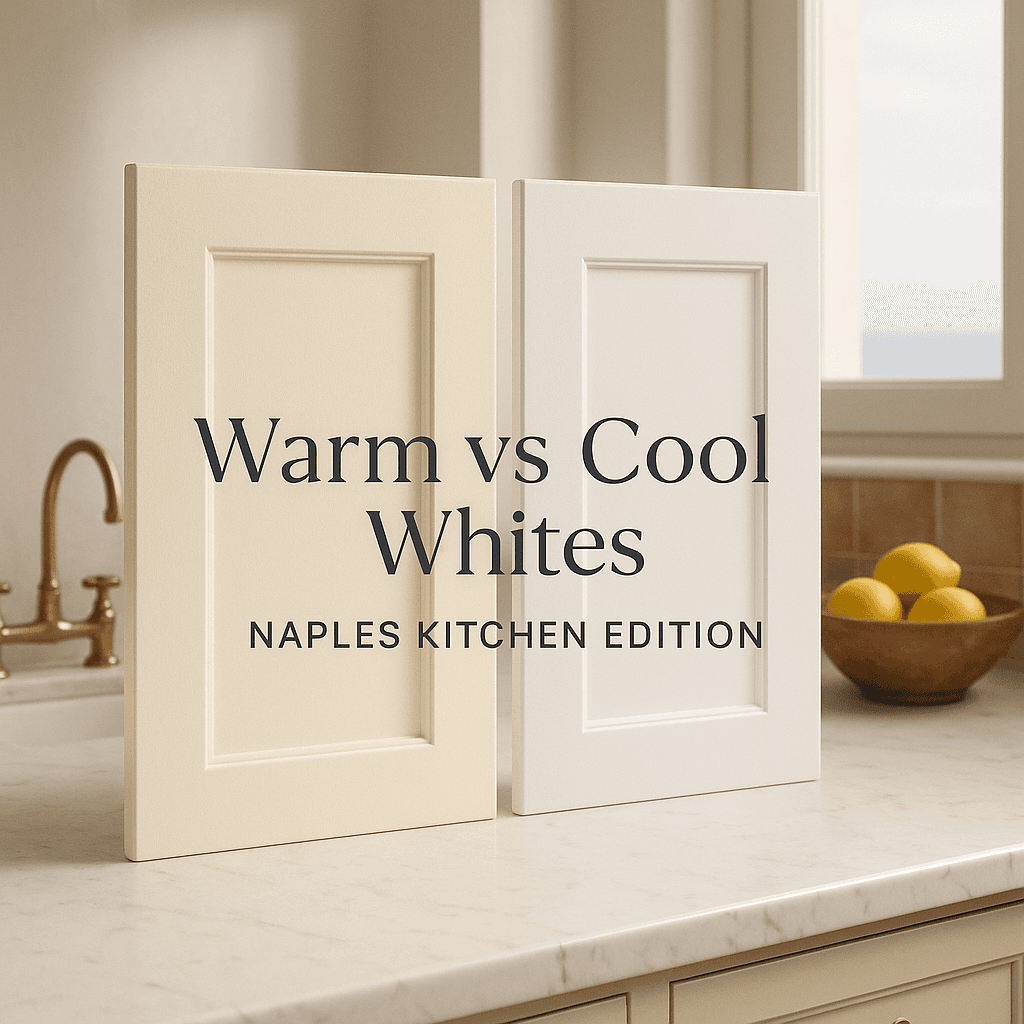
If you have ever walked into a kitchen showroom and thought, why does this white look creamy here but kind of blue over there. You are not imagining it.
In Naples, this gets extra confusing because we live with bright sun, reflective water, big sliders, and a lot of light bouncing off tile floors. White is never just white. It is basically a mood that changes hourly.
So let’s talk about warm whites vs cool whites, but specifically for Naples kitchens. Not generic advice. Real world, coastal Florida, high light, palm trees outside, and a fridge that you definitely want to look expensive next to.
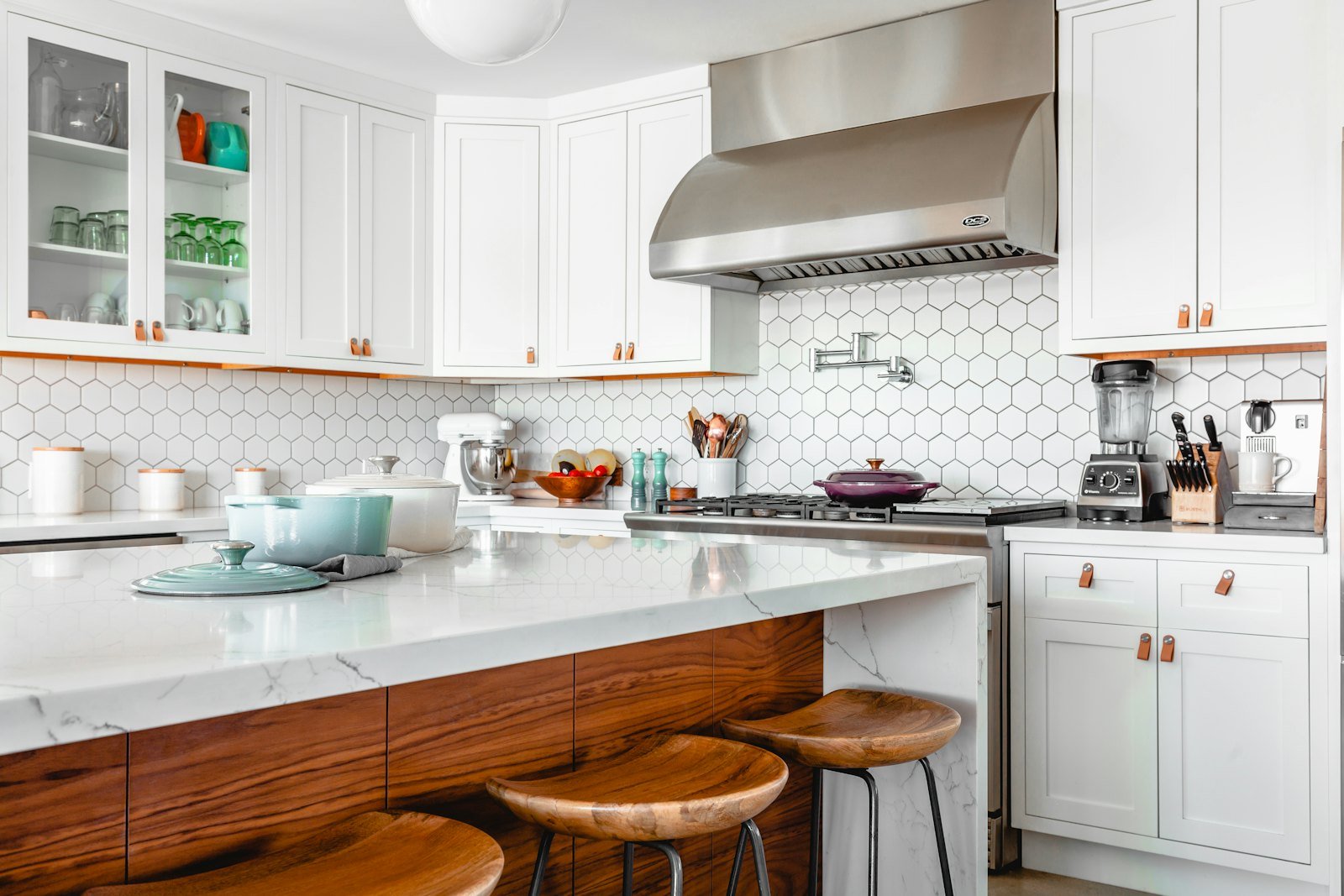
First, what “warm” and “cool” white actually means
Warm whites have undertones that lean yellow, cream, beige, sometimes even a tiny touch of red. They feel softer. More relaxed. Less stark.
Cool whites lean blue, gray, sometimes a hint of green. They feel crisp. Clean. Modern. Sometimes a little clinical if you push it too far.
The tricky part is undertones do not show up the same way in every house. Naples light is intense, and it can wash colors out, or it can amplify them depending on what else is happening in the room.
So when someone says, “I want white cabinets,” the next question is: what kind of white, under your light, next to your floors, counters, and backsplash.
Naples light changes the whole game
Naples kitchens often have:
- Big windows or open layouts
- Lots of reflective surfaces (quartz, polished tile, glass)
- Warm exterior light in the morning and late afternoon
- Harsh, bright overhead lighting at night if LEDs are too cool
What that means is a cool white can look extra icy during the day. And a warm white can look very creamy under warm afternoon sun. How light affects paint colors is something to keep in mind while choosing the right shade.
Also, the greenery outside matters. If your kitchen looks out onto landscaping, a “neutral” white can pick up a slight green cast. This can be reminiscent of the gray wall turned blue-green phenomenon. It’s subtle but you will notice it when your cabinets suddenly look different than your sample.
Warm whites in a Naples kitchen (when they look amazing)
Warm whites are a really natural fit for Naples homes because they play nicely with coastal palettes and all the sandy tones we tend to have around here. They also help a kitchen feel inviting instead of sterile.
Warm whites work especially well if you have:
- Wood floors (oak, engineered wood, anything with warmth)
- Creamy or beige tile
- Gold, champagne bronze, or brass hardware
- Warm veined quartz (think soft taupe or gold veining)
- A more traditional or transitional style (Shaker doors, crown details, etc.)
The upside
Warm whites are forgiving. They hide minor smudges better. They make a kitchen feel like a place people actually live.
The downside
If you pair a warm white with a cool countertop or cool gray flooring, it can look “dirty” or yellowed. Not because it is, but because your other finishes are pulling the room cooler, and the cabinet white suddenly looks like it is trying too hard.
A Naples specific note
Warm white cabinetry with a soft white quartz and brushed brass hardware is basically a cheat code here. It looks expensive without feeling flashy.
Cool whites in a Naples kitchen (when they look sharp, and when they don’t)
Cool whites can be stunning. Like magazine cover stunning. But they have less tolerance for mismatched lighting and finishes.
Cool whites are a good choice if you have:
- Cool gray or concrete look tile floors
- White quartz with gray veining (Carrara style)
- Chrome or polished nickel hardware
- A modern slab door cabinet style
- Black accents (black pulls, black faucet, black window frames)
The upside
Cool whites feel clean and modern. They can make a smaller kitchen feel bigger. They also photograph beautifully if you get the lighting right.
The downside
In Naples daylight, some cool whites can drift bluish. And at night, if your recessed lights are 4000K or 5000K, the kitchen can start feeling like a dentist office. No one wants that vibe while making pasta.
Also, cool whites show contrast more. If your trim is a different white, or your ceiling paint is a different white, you will see it immediately.
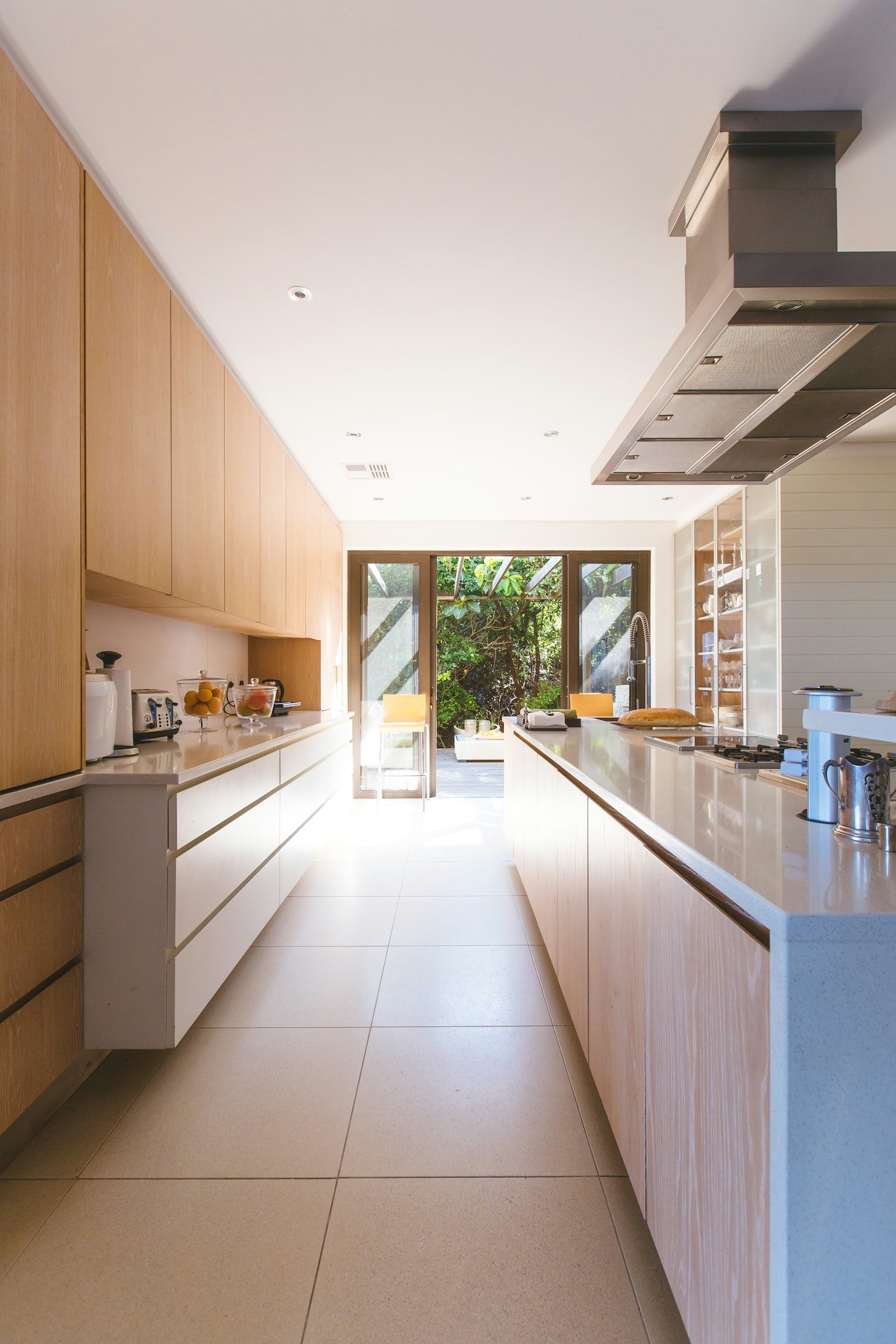
The fastest way to decide: start with your “fixed” finishes
Here is the part that saves people from expensive regret. Don’t start with cabinets. Start with what you are not changing, or what you already know you want.
Ask yourself:
- What is my flooring tone. Warm or cool?
- What is my countertop tone. Warm or cool?
- What metals am I using. Warm (brass) or cool (chrome/nickel)?
- What direction does my kitchen face. East, west, north, south?
- What color temperature are my lights going to be at night?
Then pick your white to support that direction.
If your counters and floors lean warm, pick a warm white. If they lean cool, pick a cool white. If you are mixed, you probably need a neutral white that is carefully chosen and tested.
Neutral whites exist, but they are not magic
A lot of homeowners say, “I just want a neutral white.” Which is fair. But neutral whites still have undertones. They are just quieter about it.
In Naples, the most “safe” neutral whites tend to be the ones that do not go too yellow and do not go too blue. The middle zone. But you still have to test them.
And here’s the thing. Your backsplash can flip the entire decision. A warm backsplash next to a cool cabinet makes the cabinet look colder. A cool backsplash next to a warm cabinet makes the cabinet look yellower. It’s a seesaw.
Lighting: the thing that ruins good white choices
If I could only give one piece of advice, it would be this. Stop choosing white paint under showroom lighting and thinking it will behave at home.
Use this simple lighting rule in kitchens
- 2700K to 3000K: warm, cozy, flattering. Great for warm whites and most Naples interiors.
- 3500K: more neutral. A nice compromise if you want crisp but not icy.
- 4000K+: cooler, brighter, can make whites look blue or gray fast.
A lot of Naples kitchens look best around 3000K at night. It keeps the space warm but still clean. Especially with white cabinetry.
Also, if you do under cabinet lighting, make sure it matches or complements your ceiling lights. Mixed temperatures make whites look chaotic.
Quick match guide (Naples edition)
If you want that soft coastal luxury look
- Warm white cabinets
- Light warm quartz
- Natural wood accents
- Brass or champagne bronze hardware
- Warm white lighting (around 3000K)
If you want sleek modern coastal
- Cool white cabinets
- White quartz with gray veining
- Minimal backsplash
- Chrome or polished nickel
- Neutral lighting (3000K to 3500K, avoid too blue)
If you want timeless and flexible
- A balanced neutral white (test it)
- Countertops that are not too warm or too icy
- Brushed nickel or a muted brass
- Keep the backsplash simple and not overly patterned
Common Naples kitchen combos that go wrong
This is the “learn from other people’s pain” section.
Warm white cabinets + cool gray tile + cool LED lights
The cabinets can look yellow. The floor looks purple gray. The lights make everything worse.
Cool white cabinets + beige travertine floors
The cabinets can look blue. The travertine looks extra orange. The contrast feels accidental.
Two different whites that are “close enough”
They are never close enough. Ceiling white vs cabinet white vs trim white. In Florida light, you will see it.
How to test whites the right way (so you don’t guess)
Do this, even if you are sick of samples.
- Get peel and stick samples or large paint swatches.
- Put them next to your countertop sample and flooring sample.
- Check them at different times: morning, mid day, late afternoon, and night with all lights on.
- Look at them from across the room, not just up close.
If you are remodeling, it also helps to test near the sink wall and near the range wall. Light behaves differently in different corners.
For more detailed advice on selecting paint colors for your home, you might find these expert tips helpful.
A quick word on cabinets vs walls (they don’t have to match)
You do not need the cabinet white and wall white to be identical. Sometimes that looks flat.
In fact, a common high end approach uses three coordinated but distinct whites: cabinets in a soft white, walls in a slightly warmer or slightly cooler white that feels clearly intentional, and trim either matched to cabinets or slightly crisper.
The key is coordination, not cloning.
Pulling it all together for your Naples remodel
Warm whites tend to make Naples kitchens feel relaxed, welcoming, and coastal in a natural way. Cool whites tend to make them feel crisp, modern, and sharp. Neither is “better.” The best choice is the one that behaves well with your fixed finishes and your lighting.
And honestly, if you are already investing in a custom kitchen, this decision deserves more than a quick pick from a fan deck.
If you want a second set of eyes on your cabinet white, countertop direction, and lighting plan, Cutting Edge Builds can help you plan it as part of a full kitchen remodel in Naples. You can take a look at their work and request a consultation here: https://kitchen-remodeling-naples-fl.com/
Because choosing “white” is easy. Choosing the right white for your kitchen, in this sun, with those floors. That’s the part that pays off every single day.
FAQs (Frequently Asked Questions)
Why does white paint look different in various parts of a Naples kitchen?
White paint can appear creamy in one spot and bluish in another because of Naples’ unique lighting conditions, including bright sun, reflective water, large windows, and light bouncing off tile floors. These factors cause white to change its appearance throughout the day.
What is the difference between warm whites and cool whites in kitchen cabinetry?
Warm whites have undertones of yellow, cream, beige, or a hint of red, giving a softer and more relaxed feel. Cool whites lean towards blue, gray, or green undertones, creating a crisp, clean, and modern look. The choice depends on your kitchen’s lighting and finishes.
How does Naples’ natural light affect the choice of white paint for kitchens?
Naples kitchens often have intense natural light from big windows and reflective surfaces. Warm afternoon sun can make warm whites look creamier, while cool whites may appear icy during the day. Additionally, outdoor greenery can cast subtle color reflections affecting how white paint looks indoors.
When are warm white cabinets ideal for a Naples kitchen?
Warm white cabinets work best with wood floors (like oak), creamy or beige tiles, gold or brass hardware, warm veined quartz countertops, and traditional or transitional styles such as Shaker doors. They create an inviting atmosphere that complements coastal palettes.
What are the pros and cons of choosing cool white cabinetry in Naples kitchens?
Cool whites offer a clean, modern aesthetic that can make smaller kitchens feel larger and photograph beautifully. However, under Naples daylight they may appear bluish, and harsh overhead LED lights can give a clinical ‘dentist office’ vibe. They also highlight contrasts between different whites in trim or ceilings.
How should I decide between warm and cool white cabinets for my Naples kitchen?
Start by assessing your fixed finishes like flooring tone (warm or cool), countertops, hardware style and color. Warm whites pair well with warm-toned floors and gold hardware; cool whites suit gray floors and chrome hardware. Considering your existing elements helps avoid costly mistakes and ensures cohesive design.