
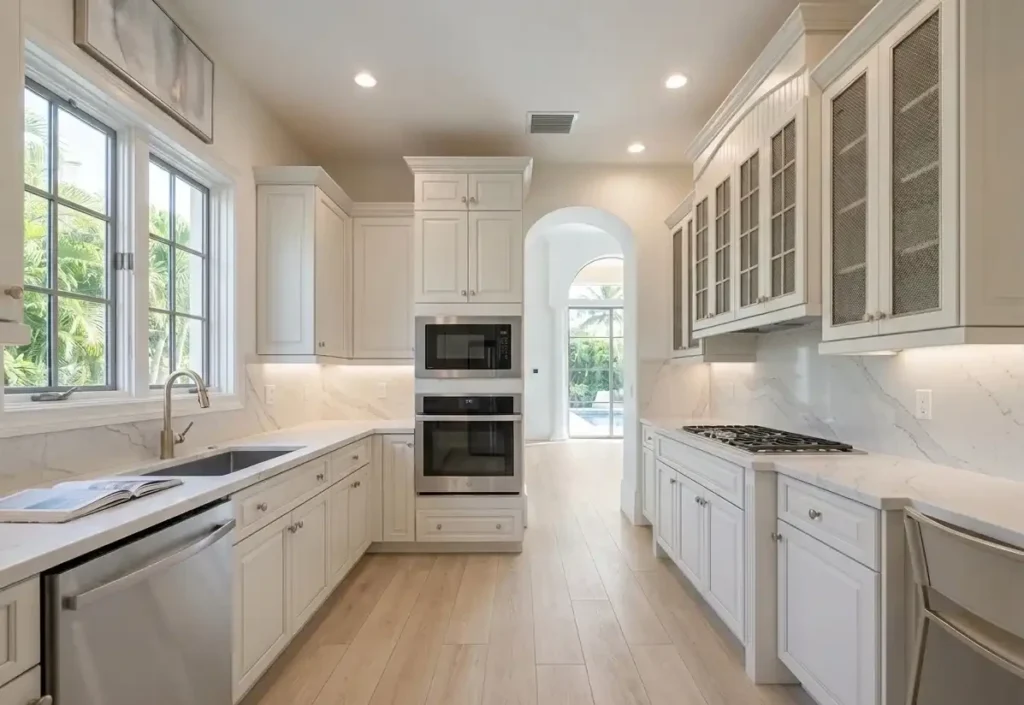
Crown Molding Installation
Scaled to Tall Florida Ceilings
Installing crown molding means fitting angled trim at the joint between wall and ceiling, coping the inside corners, mitering the outside corners and scarf-joining long runs. Ceiling height drives the profile: 8-foot ceilings suit a 3 to 4 inch crown, while 10 to 12 foot ceilings call for 6 to 10 inches of crown, or a built-up profile. Price is set by linear footage, material, profile size, corner count and whether you have tray or vaulted ceilings, so the real number comes from an on-site measure.
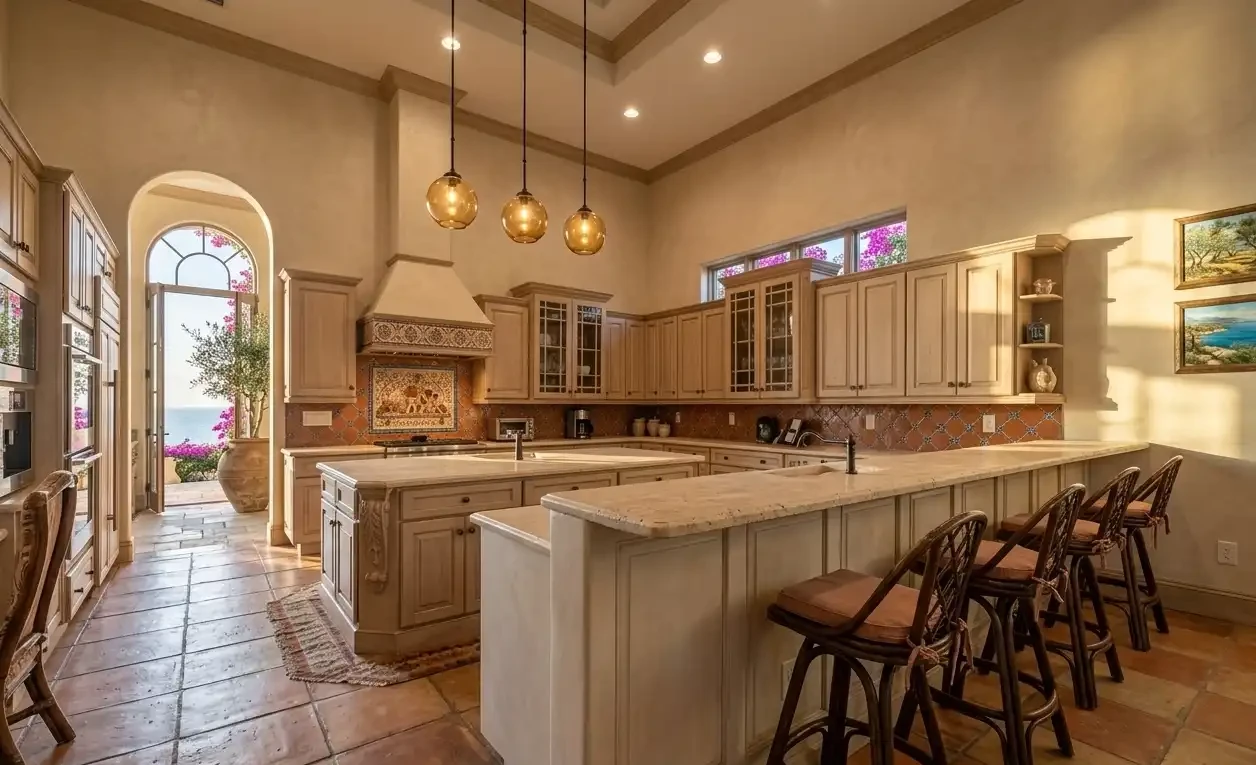
Which Crown Molding Profile and Material Should You Choose?
Getting the scale right matters more than the style. On a tall ceiling, skinny crown looks like an afterthought, while an oversized profile makes a small room feel heavy. One common guideline is about an inch of crown height per foot of ceiling height, then adjusted for the size of the room. For high ceilings, carpenters frequently stack two or three pieces, say a crown above a frieze board plus a small bed molding, to get a big, layered profile without one huge piece of trim.
Which material you pick comes down to paint, budget and where it goes. Primed MDF is smooth, stable and affordable in painted rooms, but it swells when wet. Finger-jointed pine and poplar paint nicely and grip nails better. Polyurethane foam crown is lightweight and resists moisture, so it makes sense in bathrooms and for very large profiles. Stained crown calls for solid hardwood matched to the cabinets. Each corner, each change in ceiling plane and each tray ceiling adds install time, which explains why two same-size rooms can be priced very differently.
| Ceiling height | Typical crown size | Common approach |
|---|---|---|
| 8 ft | 3–4½ in | One-piece crown |
| 9 ft | 4½–5½ in | One piece, or crown plus a small bed molding |
| 10 ft | 5½–7 in | Larger one-piece or a two-piece build-up |
| 11–12 ft | 7–10 in | Built-up crown over a frieze board |
| Tray ceiling | Depends on the step | Crown on every tier, sometimes with LED cove |
Explore what our carpenters build, from crown and wainscoting to complete built-ins and millwork.
What Is Different About Southwest Florida Homes?
Exterior walls in many local homes are concrete block, finished with furring strips and drywall, and roof trusses sit above the ceiling. Seasonal swings in temperature and moisture can lift trusses a little, which sometimes opens a crack along the top edge of the crown. Skilled carpenters fasten and caulk crown so it travels with one surface rather than splitting between two. On block walls, the nails have to land in furring or framing, not bare concrete, or the trim will work loose over time.
Humid air rewards stable materials. In conditioned rooms MDF is fine, but it doesn’t belong in bathrooms or on lanais, where polyurethane or PVC trim lasts longer. Newer homes in Naples and on Marco Island often have 10 to 12 foot ceilings, which makes built-up profiles worth a look. If you’re a seasonal owner, crown is a smart project for while the house is empty, because every room ends up with ladders, cutting stations and paint. Crown on its own seldom needs a permit, but it is often part of bigger remodels that do, like kitchens and primary suites.

Crown Molding Installation Before &


Crown Molding Questions
How do contractors price crown molding installation?
Most carpenters charge for crown by the linear foot, then adjust for the material, the size of the profile, any built-up layers, the number of corners, ceiling height and paint. Tray and vaulted ceilings take more time. With that many variables, we measure your rooms and give a fixed quote instead of guessing from square footage.
What size crown molding works with 10-foot ceilings?
With 10-foot ceilings, crown between 5½ and 7 inches usually looks in proportion, as does a two-piece build-up of about the same total height. Bigger rooms can take more. It often helps to see two sizes side by side in a 3D render before any trim is cut.
Can you use MDF crown molding in Florida?
In air-conditioned living areas, primed MDF performs well: it stays stable and takes paint smoothly. Keep it out of bathrooms, laundry rooms and anywhere it could get wet, because it will swell. In those spaces, polyurethane or PVC crown is the safer pick.
We scan every room, render crown profiles side by side and price the install at one fixed number.
More in Carpentry & Custom Built-Ins
Finish Carpentry Clients Pick Cutting Edge
Great crown molding takes carpenters who size profiles to the room and cope tight corners, plus an understanding of how Florida trusses and block walls behave. With its own finish crews, Cutting Edge Kitchen & Bath has more than 500 Southwest Florida remodels behind it and nine Best of Houzz awards, and we serve Naples and Marco Island. Trim and millwork are on display next to cabinetry at our Bonita Springs showroom, 28280 Old 41 Road. Every project kicks off with a free LiDAR scan; the photo-real 3D render that follows shows the profile in your own room, and only then do you sign one fixed-price contract.