

Glass Wine Cellar
Built for Florida Humidity
A glass wine cellar is a cooled wine room whose walls or doors are made of insulated glass, which turns the collection into part of the home's design. For it to perform, you need insulated glazing, an unbroken vapor barrier in the solid walls and ceiling, a gasketed door, and cooling sized for the added heat that comes through the glass. The usual target is roughly 55°F with humidity kept moderate. Here in Southwest Florida, sloppy thermal details make the glass sweat, so the engineering deserves as much attention as the look.

How Is a Glass Wine Cellar Built?
Glass is both the centerpiece and the weak spot. A single pane admits heat and fogs over, so cellars rely on insulated double- or triple-pane units, frequently with low-E coatings and a gas fill. Frameless walls held in thin metal channels create the most open feel, and steel-framed glass gives a more architectural look. To keep the cold in, the door gets seals all the way around and a sweep along the bottom.
Everything else in the room handles the work you don’t see. The solid walls and ceiling are insulated and wrapped with an unbroken vapor barrier on the warm side, while racks of metal, wood or acrylic store bottles either label-out or in bulk. Cooling can be a through-wall self-contained unit, a ducted split with the condenser placed remotely, or a ductless split, and because glass walls bring in extra heat, the unit has to be bigger. LED fixtures keep both heat and UV to a minimum. Cost climbs with how much glass you use, which cooling system you choose, the racking materials and the bottle count. Our wine display packages start from $12,500. Many owners also set a tasting counter or bar just outside the glass.
| Cooling system | How it operates | Pros | Cons |
|---|---|---|---|
| Self-contained through-wall | Wall-mounted unit vents heat into a neighboring room | Lowest cost, easy install | You can hear it; the next room has to take the heat |
| Ducted split | Remote evaporator, condenser outdoors | Quiet inside the cellar, suits bigger rooms | Costs more, requires a line set and duct runs |
| Ductless split | Wall-mounted head with an outdoor condenser | Quiet, no ductwork | The head is visible in the cellar |
| Ducted self-contained | Unit sits in a nearby closet or attic, ducted to the cellar | Quiet, equipment out of sight | Requires room and service access |
Browse our Good, Better and Best wine display packages, from cellars under the stairs to wine rooms walled in glass.
What Changes in an Open-Plan Naples Home?
Keeping wine cool is tough in Florida. For most of the year the outdoor air is very humid, and whenever the glass or part of a wall drops below the dew point of the air around it, moisture beads up on the house side. Insulated glazing, an unbroken vapor barrier and steady air movement keep that from happening. Location counts as well: a cellar hit by afternoon sun through a west-facing window or lanai slider absorbs much more heat than one tucked into the middle of the house.
Summer storms and the odd power outage put the system to the test too. Wiring the cellar to a whole-house generator, or adding monitoring that warns you of temperature swings, keeps the collection safe, and that matters most for seasonal owners who are gone for months. In the open layouts common to Naples and Marco Island homes, the cellar often lands between the kitchen and the dining area and becomes the room’s focal point. A wine room inside a condo usually needs the association to approve the electrical work and where the condenser goes, so we start that process early.

Glass Wine Cellar Before &

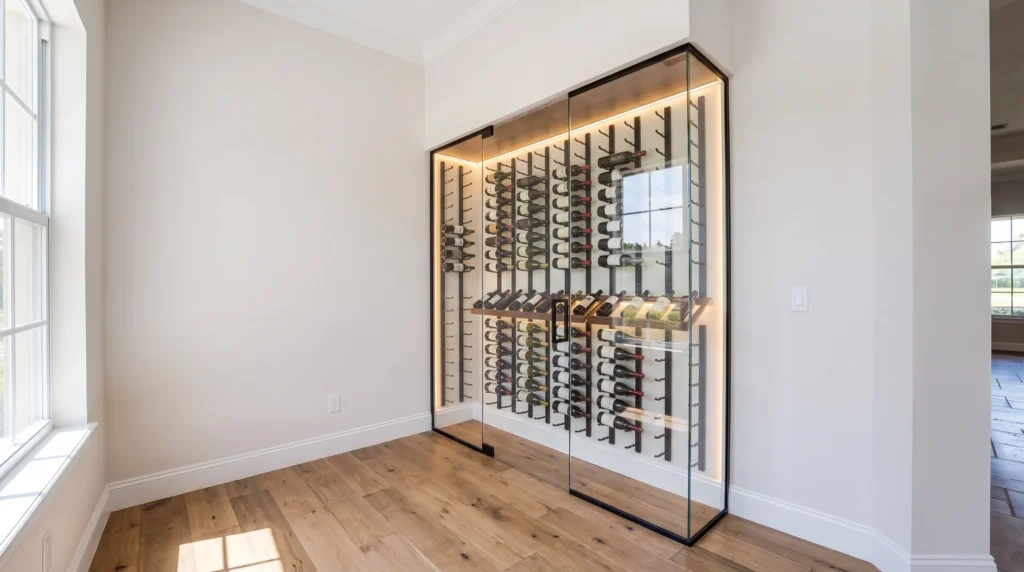
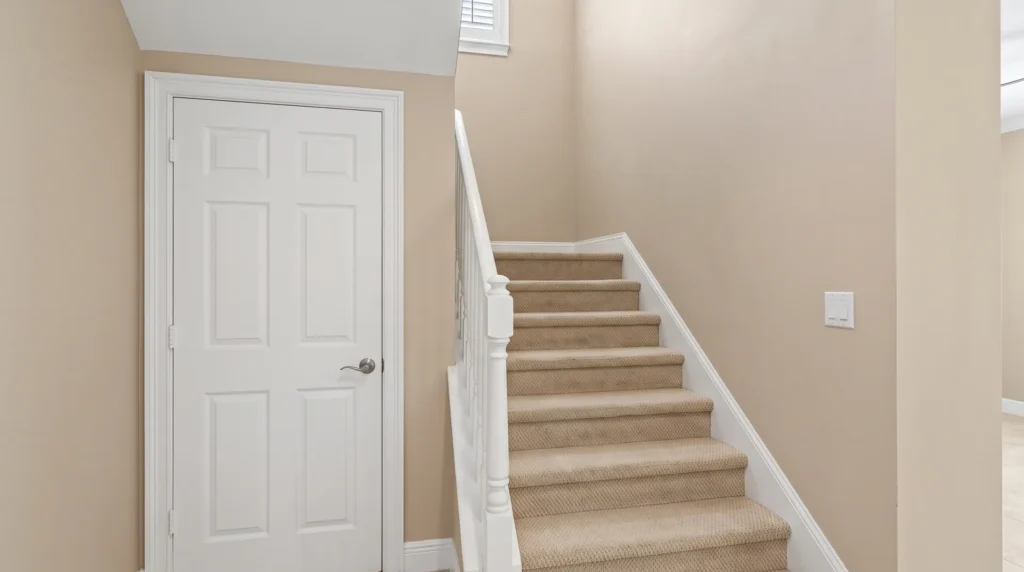


Glass Wine Cellar Questions
What makes the glass on a wine cellar fog?
Fog forms when the glass surface sits below the dew point of the air against it. The cause can be single-pane glass, a failed seal in an insulated unit, no vapor barrier, or weak airflow around the glass. In most cases, insulated low-E glass and proper sealing fix it.
What temperature should a wine cellar be kept at?
For long-term storage, about 55°F is the usual goal, with humidity held moderate so corks stay supple and labels stay free of mold. Keeping the temperature steady is more important than landing on a precise number, and that is why the cooling unit has to be sized to both the room and its glass.
Can a glass wine cellar go under the stairs?
Absolutely. The area under a staircase is a favorite spot because the space would otherwise go unused. It still calls for insulation, a vapor barrier, a sealed glass front and a cooling unit with a place to dump its heat, all of which we work out during design.
We scan the room, render your glass and racking choices, size the cooling and hand you a single fixed price.
More in Under-Stairs Wine Cellar & Wine Wall
Why Collectors Choose Cutting Edge
In Florida, a glass wine cellar is really an engineering job dressed in a showpiece finish. Cutting Edge Kitchen & Bath, a licensed Florida general contractor, designs the glazing, vapor barrier, cooling and racking as one plan, beginning with a free LiDAR scan and a photo-real 3D render of your room. We are also the exclusive Florida distributor of Designer Stone Panels, so a backlit stone wall can go behind the racks. Our crews build it under a single fixed price, backed by more than 500 Southwest Florida remodels, nine Best of Houzz awards, our Naples office and our Bonita Springs showroom at 28280 Old 41 Road.