

Wine Cellar Cooling Units
Sized for Florida Heat
A cooling unit built for wine keeps a sealed room near 55°F and holds humidity at a moderate level, usually in the 50 to 70 percent range. You will see three main kinds: self-contained units that mount through a wall, split systems that put the condenser outdoors, and ducted systems that tuck the equipment into a closet or attic. Which one fits comes down to the cellar’s volume, its insulation, how much glass it has, the quality of the door and how warm the rooms around it run. Here in Florida, getting the insulation and vapor barrier right counts just as much as the unit you pick.

How Do Wine Cellar Cooling Systems Compare?
The through-wall self-contained unit is the most basic option. One box is set into the cellar wall, chills the wine side and pushes its heat out the back into the neighboring room. If that room is too small or too warm to take the heat, the unit labors and never shuts off. With a split system, the evaporator lives in the cellar and the condenser sits outdoors or in the garage, joined by refrigerant lines, which keeps the cellar quiet and sends the heat out of the house. A ducted system puts the entire unit somewhere else and delivers chilled air through ductwork, so you neither see nor hear the equipment.
Picking a size means doing a load calculation rather than guessing. The installer looks at the cubic footage, the wall and ceiling insulation, how much glass there is and what kind, the door, the lighting, and how warm the neighboring spaces get. Glass walls are beautiful, but they pull in heat, so they need insulated glass and a bigger unit. Go too big and the unit short-cycles and can’t control humidity; go too small and it never stops running. Nearly every system produces condensate, so plan for a drain line or a condensate pump.
| Type | Where heat is sent | Noise in the cellar | Best suited to |
|---|---|---|---|
| Self-contained through-wall | Into the neighboring room | Noticeable | Small cellars beside a big, cool room |
| Ducted self-contained | Ducted from a remote closet or attic | Low | Mid-size cellars with hidden equipment |
| Split system | Condenser outdoors or in the garage | Low | Glass cellars and bigger rooms |
| Ducted split | Outdoor condenser with ducted air handler | Very low | Showpiece cellars with nothing visible |
| Wine refrigerator | Into the surrounding room | Moderate | Small collections, no room to build |
Browse our wine cellar, wine wall and backlit stone display packages, each one climate-controlled from day one.
Why Does Florida Change the Spec?
Up north, a cellar mostly battles warm air coming from the rest of the house. Here in Southwest Florida, heat and humidity press in from nearly every side. Damp, warm air moves toward the cold room, so the vapor barrier belongs on the warm face of the insulation, which in our climate is the exterior side of the cellar walls and ceiling, with no gaps anywhere. Many builders use closed-cell spray foam because one layer both insulates and stops vapor. You also need an exterior-grade door with gaskets and a sealed threshold, and any recessed lights should be sealed fixtures or LED so they don’t add heat.
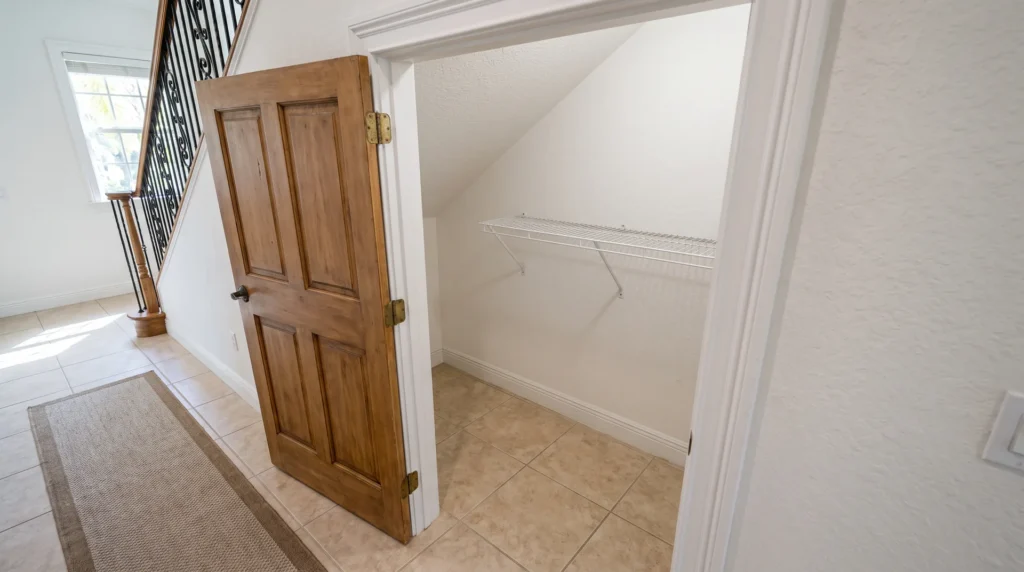
Where the cellar sits makes a difference as well. In Naples and Marco Island homes, a cellar under the stairs or in an interior closet is far easier to keep cold than a room built against an outside block wall that takes the afternoon sun. An outdoor split condenser has to be mounted and tied down for wind, shielded from salt air, and raised up if the home is in a flood zone. If you’re a seasonal owner, choose a unit that sends remote alerts and, ideally, plan for backup power, because a summer outage can drive the temperature up fast. Our wine display packages start from $12,500.

Wine Cellar Cooling Before &


Wine Cellar Cooling Questions
Can a standard air conditioner cool a wine cellar?
Not effectively. A household AC is built to bring a room down to roughly 70°F while pulling out lots of moisture, and that dry air shrinks corks. Units made for wine cellars hold close to 55°F and keep humidity moderate, which is the condition wine needs for long-term storage.
How is a wine cellar cooling unit sized?
Your installer works out a heat-load calculation from the room’s volume, insulation, glass, door, lighting and how warm the adjoining spaces are. The manufacturer’s sizing charts are only a starting point, and in Florida the answer often ends up being a bigger unit.
Does a Florida wine cellar need a vapor barrier?
It does. If the warm side lacks an unbroken vapor barrier, moist air condenses inside the wall cavity, and mold and ruined finishes follow. In this area the standard fix is closed-cell spray foam or a sealed membrane behind the insulation.
Before we build, we scan the room, work out the cooling load and show you the cellar in a 3D render.
More in Under-Stairs Wine Cellar & Wine Wall
Why Collectors Trust Cutting Edge
In Southwest Florida, a wine cellar is a climate-control job before it is a showcase. Cutting Edge Kitchen & Bath is a licensed Florida general contractor with a Naples office, and we plan the vapor barrier, insulation, door, cooling system and drain together before adding racking and lighting. Because we are the exclusive Florida distributor of Designer Stone Panels, a backlit stone wine wall is an option too. Behind our free LiDAR scan, photo-real 3D render and single fixed-price contract built by our own crews stand more than 500 Southwest Florida remodels and nine Best of Houzz awards.