

Faux Stone Wall Panels
Compared With Real Stone
Faux stone wall panels are molded sheets, most often polyurethane or a similar foam, formed and painted to imitate stacked stone or brick. They cost little, weigh almost nothing and go up fast, yet up close you can tell they are fake. Real stone veneer looks genuine, but it is heavy and calls for masonry prep. Designer Stone Panels fall into a third group: real onyx, marble and quartzite sliced to about 8mm, light enough for a wall or ceiling and translucent enough to light from behind. Cutting Edge holds the exclusive Florida distributorship.

Faux, Thin and Full Stone: How Do They Stack Up?
Polyurethane faux panels come from molds taken off real stone, which means the texture repeats every few feet and the color is paint applied at the factory. You can screw or glue them onto drywall in a single afternoon, and that speed is why people use them on accent walls, bar fronts and rental makeovers. What you give up is realism. Unstaggered seams are obvious, corners and edges need trim pieces, and a hollow sound when tapped or a scuff that exposes foam tells everyone what it is.
Genuine stone veneer, whether thin-cut natural stone or full-thickness pieces, has the weight and variation a faux panel can never match, but the wall has to be built for it: lath or cement board, mortar and framing that can hold the load. Designer Stone Panels go another way. The stone itself is real, sliced thin and bonded to a backing to keep it light, and with LED lighting placed behind onyx or some marbles, the natural veining lights up. That puts them in the feature-material category for fireplace surrounds, wine displays, showers, bar fronts and ceilings, not the budget-substitute category. Price tracks the stone you pick, how many panels, the backlighting and the wall prep.
| Polyurethane faux panels | Real stone veneer | Designer Stone Panels | |
|---|---|---|---|
| Material | Molded foam, painted finish | Natural or manufactured stone | Real onyx, marble or quartzite |
| Realism up close | Pattern repeats and can look fake | Authentic | Authentic, natural veining |
| Weight | Very light | Heavy; needs structural support | Light for real stone, roughly 8mm thin |
| Backlighting | Not possible | Not possible | Translucent stones glow with an LED backlight |
| Install | Adhesive or screws over drywall | Mortar over cement board or lath | Engineered panel system set by trained installers |
| Best use | Rentals and low-budget accent walls | Exterior walls, columns, fireplaces | Feature walls, showers, bars, fireplaces, ceilings |
| Relative cost | Lowest | Mid to high | Premium |
Browse backlit onyx, marble and quartzite panels that, in Florida, you can only get through Cutting Edge.
What Counts in a Florida Home?
Heat and humidity affect how a wall finish ages. Foam panels do fine indoors, but out on a lanai in full sun the paint can fade, and any panel fastened to a wall without the right moisture detailing can hold water behind it. Real stone stands up to weather but brings weight, and on a block home it still needs the correct lath or bonding layer over the stucco. Near a pool, an outdoor kitchen or beachfront exposure, how the material is chosen and attached counts for more than how it looks the day it goes up.
Indoors, in the air conditioning, Designer Stone Panels make things possible that thick stone can’t, like a backlit onyx wall in the great room or a shower wall that glows in the primary bath. Since lighting is built into the system, we work out the electrical, drivers and access at the design stage, not afterward. If you own a condo in Naples or Marco Island, plan on association review whenever a wall finish involves new wiring or touches shared walls, and the electrical work will usually require a permit.

Can Faux Panels Go on a Ground-Floor Wall in a Naples Flood Zone?
Flood rules are the first local question for any wall finish low in a Collier County house. FEMA Technical Bulletin 2 (January 22, 2025) defines a flood damage-resistant material as one that can withstand direct and prolonged contact with floodwater without significant damage, and it defines prolonged as at least 72 hours. It says building materials below the base flood elevation in a Special Flood Hazard Area must meet that standard. In its wall tables, cement board, non-paper-faced gypsum board and mortar-set ceramic or porcelain tile are rated acceptable, while paper-faced gypsum board, tile set with organic adhesives, and wall coverings such as vinyl, plastic or paper are rated unacceptable.
Bulletin 2 does not name decorative foam panels, so we cannot tell you how a given product is classified. What it does show is that glue-on panels over ordinary paper-faced drywall are a poor bet below flood elevation, and that a mortar-set stone or tile assembly is the more defensible route. For a specific wall, call the floodplain staff at your jurisdiction. The City of Naples floodplain page says nearly all permitted development gets a floodplain review, and Collier County Floodplain Management can be reached at 239-252-2942. Confirm these details with the building department before you rely on them.
Maps are moving too. Collier adopted a revised coastal flood map on February 8, 2024, and a preliminary countywide flood insurance rate map was released in March 2025, with a 90-day appeal period that began August 19, 2026 and an effective date targeted for summer 2027, which the county says may change. The National Weather Service's Hurricane Ian summary reports significant to major storm surge across almost all of Collier County south and west of US-41. If your wall is inside that footprint, ask which zone and which elevation apply before you choose any finish.
What Hides Behind a Panel When the House Sits Closed?
A panel that is glued or screwed over a wall hides whatever happens behind it, and that matters in a region where many homes sit shut for part of the year. The City of Marco Island's own growth-management data counted a 2006 seasonal population of 24,521 against 15,719 permanent residents, an old figure but a useful reminder of how many houses there are closed up for months. The Atlantic hurricane season runs June 1 through November 30 and peaks around September 10, according to Fox Weather, which overlaps the months many owners are away.
The EPA's guide to mold and moisture advises drying water-damaged areas and items within 24 to 48 hours, and suggests keeping indoor relative humidity below 60 percent, ideally between 30 and 50 percent. It also warns that mold may hide on the back side of drywall, wallpaper or paneling. Put plainly: before any panel covers a wall, have the wall checked for old moisture, fix leaks at the source, and decide how you will keep the air conditioning and humidity under control while you are away. If a wall holds plumbing or sits against a shower or lanai door, ask whether the panel can be removed later without wrecking the drywall.
Condo Walls, Backlighting and Approvals in Naples and Marco
In a condominium, the first question is who owns the wall. Section 718.113(2)(a) of the 2026 Florida Statutes bars material alterations or substantial additions to the common elements except as the declaration provides, and where the declaration is silent it requires approval by 75 percent of the total voting interests. A finish on the inside face of your own unit may fall outside that sentence, but the declaration and house rules still decide. Associations differ even within one community: a local brokerage counts more than 87 residential condominium and homeowner associations in Pelican Bay alone, so a neighbor's experience may not carry over to your building.
Marco Island offers a concrete look at what a permit file asks for. The City's multi-family dwelling unit remodel application (version 2023) requires notarized owner and contractor affidavits, a floor plan of the building showing the work area and any floor penetrations, UL listings for fire-rated wall assemblies and floor penetrations, and the contractor's state license number with each subcontractor's details. If your wall is part of a fire-rated assembly, find that out before anything is fastened to it. A backlit panel adds a driver and wiring, so ask the building department whether that electrical work needs a permit. Collier's published exemption list names items such as replacing light fixtures and switches, but we did not find backlit stone on it.
Where to ask depends on the address: the City of Naples Building Department at 295 Riverside Circle covers city limits, Collier County Growth Management at 2800 N. Horseshoe Drive covers unincorporated areas, and the City of Marco Island has its own Building Services. Allow for work hours as well. The City of Naples noise ordinance, Section 22-37, allows residential work from 7 a.m. to 6 p.m. Monday through Saturday, so confirm the current rules with the building department, along with your building's elevator and delivery rules before panels arrive. If you are still choosing a finish, our stone accent wall page covers the real-stone side of the comparison.
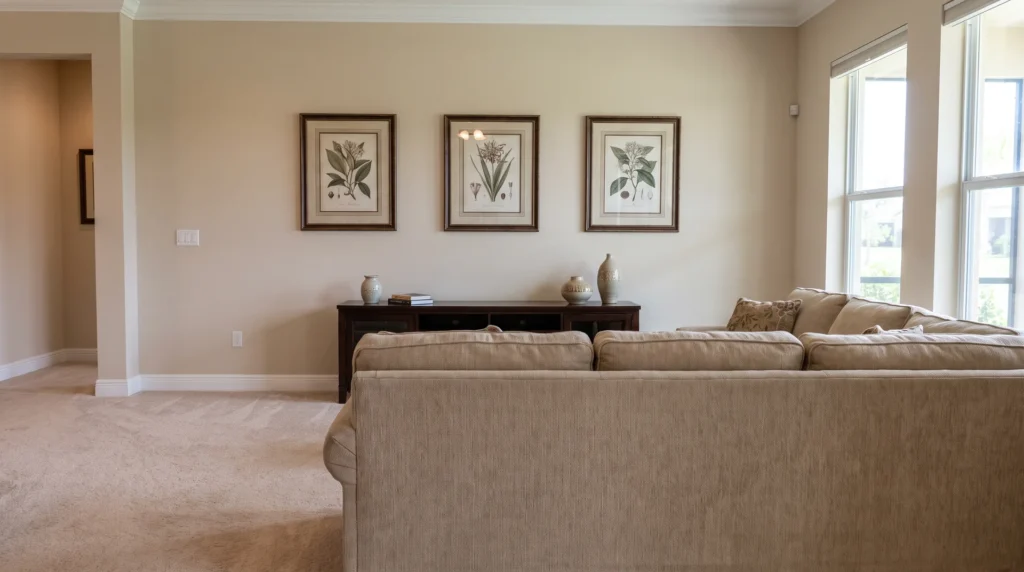
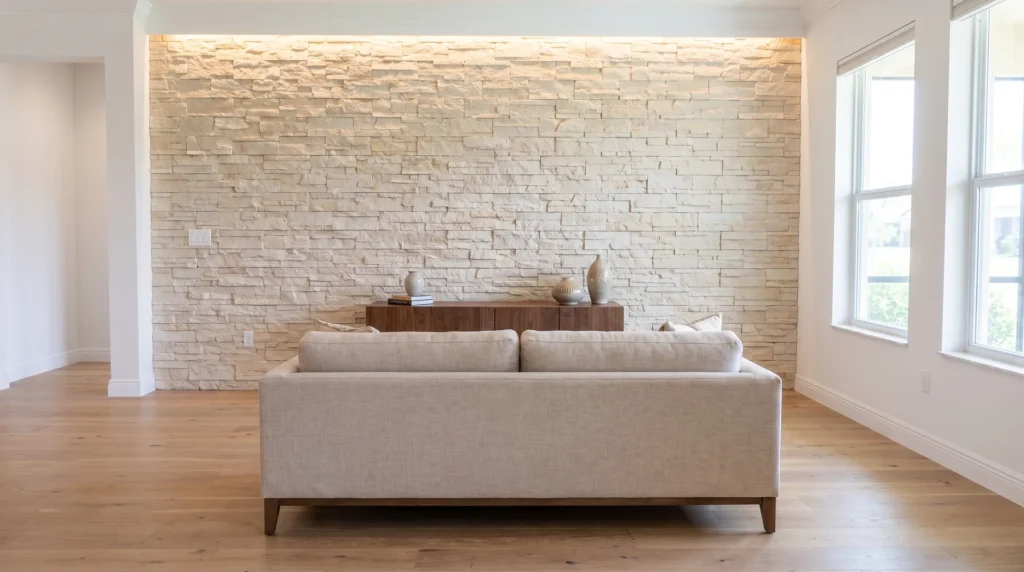
Faux Stone Wall Panels Before &



Faux Stone Panel Questions
Do faux stone panels look real?
Across a room, a good polyurethane panel can fool people. Get close, though, and the repeating mold pattern, even paint and visible seams tend to give it away. When realism is the goal, real stone veneer or genuine thin stone such as Designer Stone Panels looks right because no two pieces are alike.
Can faux stone panels be used outdoors?
A few polyurethane panels carry an exterior rating, but under Southwest Florida sun the paint can fade, and the panels need correct moisture detailing behind them. On lanais and outdoor kitchens we generally suggest real stone or a product built for full sun and salt air. Designer Stone Panels are an interior-only product.
Are Designer Stone Panels heavy?
No. They are real stone sliced to about 8mm and reinforced with a backing, so they are far lighter than full-thickness slabs or conventional veneer. That light weight is why ceilings, walls and backlit features work without the structural support thick stone needs.
Can I put faux stone panels on a ground-floor wall in a Naples flood zone?
Ask before you buy. FEMA Technical Bulletin 2 requires flood damage-resistant materials below the base flood elevation in a Special Flood Hazard Area, and it rates wall coverings and paper-faced gypsum board as unacceptable. It does not name foam panels, so the city or county floodplain office has to say how a specific product is treated.
Does a Naples or Marco Island condo need approval before I add a stone wall?
Check the declaration and house rules first. Florida law requires declaration-based or 75 percent approval for material alterations to common elements, but a finish inside your unit may be governed by your association's own renovation rules. Marco Island's multi-family remodel application also asks for UL listings on fire-rated wall assemblies.
How do I keep a paneled wall from trapping moisture while I am away for the summer?
Fix any leak before panels go on, and keep indoor humidity under control. The EPA advises drying water-damaged areas within 24 to 48 hours and keeping relative humidity below 60 percent, ideally 30 to 50 percent. It also notes that mold can hide behind drywall and paneling.
Show us the wall you’re picturing and we’ll scan it, render it in stone and hand you a single fixed price.
Why Stone Lovers Visit Cutting Edge
Cutting Edge Kitchen & Bath is the only Florida distributor of Designer Stone Panels, and you can see backlit onyx and marble in person at our 4,000-square-foot Bonita Springs showroom at 28280 Old 41 Road before making a choice; our Naples office serves homeowners in Naples and Marco Island. We are a licensed general contractor with over 500 Southwest Florida remodels and nine Best of Houzz awards, and we do the wall prep, wiring and installation in-house. Every project opens with a free LiDAR scan and a photo-real 3D render of the stone and its lighting on your own wall, then a single fixed-price contract and installation by our crews.