
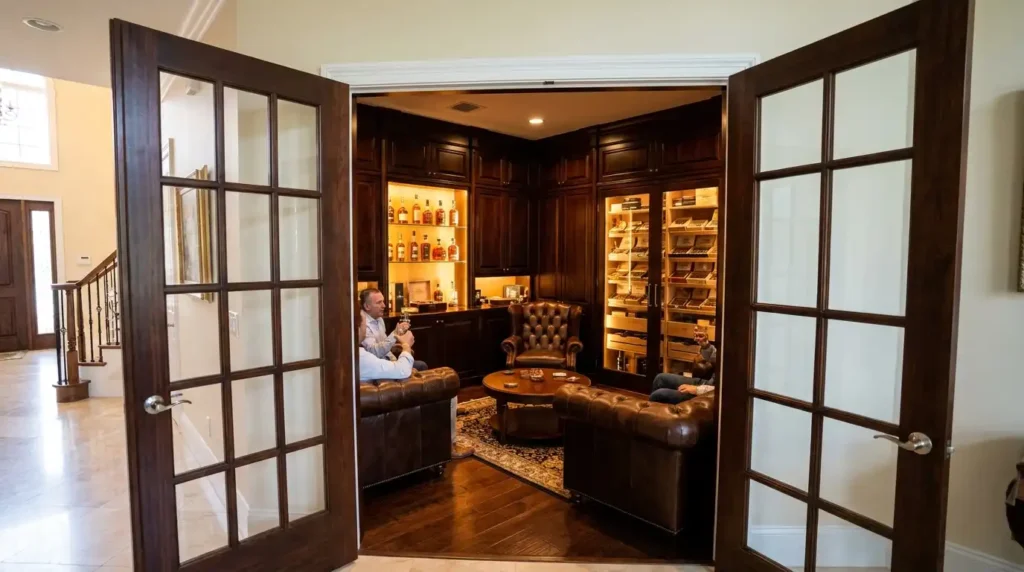
Walk-In Humidor
Made for the Florida Climate
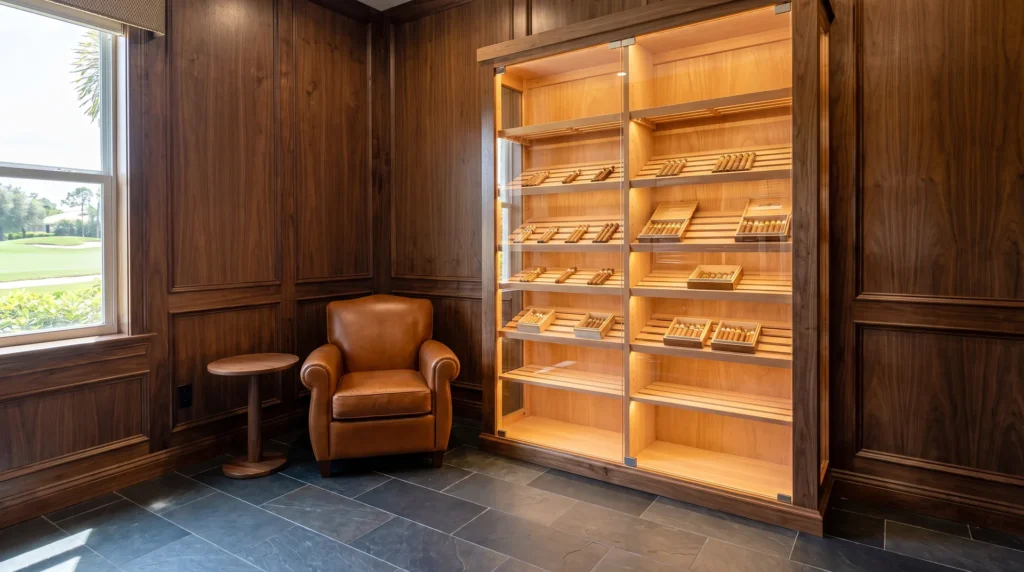
Picture a walk-in humidor as a compact, airtight room lined in Spanish cedar that keeps cigars at roughly 65 to 70 percent humidity and close to 65 to 70°F. It calls for insulated walls behind a vapor barrier, a glass door that seals tight, active humidification run by its own controller and, in most cases, dedicated cooling. The shelves, drawers and display boxes are all Spanish cedar. Inside a cigar lounge, it is usually a glass-front room just off the main seating area.

How Do You Build a Walk-In Humidor?
Start with the shell. The walls and ceiling get framed and insulated, a vapor barrier goes on the warm side, and the inside is finished in tongue-and-groove Spanish cedar, a wood that copes with humidity, discourages tobacco beetles and smells good. Tile or stone is a common floor because it holds up. A glass door gasketed around its full perimeter keeps the conditioned air in and still shows off the collection. Use low-heat LED lighting so the room never warms up and the cigars never dry out.
What really runs the room is climate control. A digital controller tells an active humidifier to add moisture as levels fall, and a dedicated cooling unit, frequently a ductless mini-split or a system built for cellars, keeps the temperature even without drying the air out the way a whole-home system tends to. A small fan moves the air so no corner goes stagnant. For storage, combine open shelving for boxes, sliding trays for single cigars and locking lockers for members or guests. Remote-alert sensors let you check the readings on your phone.
| Component | Usual approach | Why it matters |
|---|---|---|
| Lining | Spanish cedar, tongue-and-groove | Evens out humidity, deters pests, adds aroma |
| Walls | Vapor barrier plus insulation | Keeps moisture out of the wall cavities |
| Door | Fully gasketed insulated glass | Seals the space and displays the collection |
| Humidity | Controller and active humidifier, about 65–70% | Stops cigars from swelling or drying out |
| Temperature | Dedicated cooling, about 65–70°F | Prevents mold and beetle hatching |
| Monitoring | Digital sensors that send remote alerts | Flags a failure while you are away |
Browse our cigar and whiskey room packages, from a humidor closet up to a complete lounge with display and ventilation.
What Is Different in a Southwest Florida Home?
Outside, Florida air stays humid for most of the year, yet the air inside an air-conditioned house is frequently drier than a humidor wants, and the cigar lounge around it can run warm while people are using it. For that reason, the humidor should be a separately controlled room instead of leaning on the home's system. Heat is the bigger risk in this climate. Once temperatures climb above the mid-70s, tobacco beetle eggs may hatch, so dedicated cooling that keeps working through summer is money well spent.
Storm season means power outages, and if a humidor goes several days without cooling and humidity control, a valuable collection can be ruined. Many serious collectors wire the controller, sensors and cooling unit to a standby generator circuit. Part-time residents count on remote monitoring to spot trouble while they are out of town. New circuits, the cooling unit and any ductwork all need permits, and a condo association will expect to review smoke ventilation and mechanical changes. Our cigar and whiskey room packages start from $18,000, and the humidor is designed as part of the lounge.

Walk-In Humidor Before &



Walk-In Humidor Questions
What humidity and temperature should a walk-in humidor maintain?
Most collectors target roughly 65 to 70°F and about 65 to 70 percent relative humidity, and many lean toward the low end for long aging. Consistency is what counts, so dedicated cooling and an active humidifier with a controller matter more than hitting an exact figure.
Why do humidors use Spanish cedar?
Spanish cedar takes on and gives off moisture gradually, which smooths out humidity swings. It also holds up against mold and tobacco beetles, and many smokers like its scent. It is milder and lighter than the aromatic cedar found in closets, which would overwhelm cigars.
Can I turn a closet into a walk-in humidor?
In many cases, yes. A closet next to a den or cigar lounge can be insulated, sealed behind a vapor barrier, lined in Spanish cedar and given a glass door, a humidifier and cooling. During the free LiDAR scan, we look at wall space, electrical access and where the cooling unit can go.
We scan your space, render the walk-in humidor in 3D and price the build at one fixed number.
More in Whiskey Room & Cigar Lounge
Collectors Rely on Cutting Edge
A walk-in humidor must keep its climate through Florida summers and outages during storm season, so we give insulation, vapor control, cooling and backup power the same attention as the cedar millwork. Cutting Edge Kitchen & Bath is a licensed Florida general contractor serving Naples and Marco Island from our Naples office, with more than 500 Southwest Florida remodels and nine Best of Houzz awards. You can compare millwork and stone samples at our Bonita Springs showroom, 28280 Old 41 Road. Each humidor starts with a free LiDAR scan and photo-real 3D render, and our own crews build it under a single fixed-price contract.