

Tile Flooring Installation
Across the Whole Home
Installing tile through a whole home means tearing out the existing floors, getting the slab flat and solid, and laying a single uninterrupted floor across the living spaces, frequently in large-format porcelain. What you pay is driven mostly by square footage, the size and type of tile, how stubborn the old flooring is to remove, how much leveling the slab requires, and finishing items such as baseboards, transitions and furniture moving. In Florida, porcelain holds up best, luxury vinyl plank installs faster and is quieter, and wood-look tile gives you the appearance of wood with the toughness of porcelain.

What Goes Into a Whole-Home Tile Install?
The first unknown is demolition. Carpet comes up fast, but breaking out old ceramic, glued-down hardwood or terrazzo overlays is slow, noisy and dusty work, so the plan has to cover dust containment and hauling debris away. Once the old floor is gone, we grind the slab smooth, treat the cracks and fill the low areas with self-leveling compound. Big tiles show every flaw: when any edge of the tile measures 15 inches or more, industry standards require a flatter surface, since a dip a 12-inch tile would hide turns into visible lippage on a 24 by 48 inch plank.
Then the tile goes down. Laying a crack-isolation membrane over slab cracks keeps them from transferring up through the tile, and large-format porcelain gets heavy-tile mortar, a clip leveling system and back-buttering so every tile is fully supported. With wood-look planks, the offset stays small, generally a third of the plank length at most, so the floor does not look bowed. The last pieces are new baseboard, undercut door casings, thresholds at the sliders and transitions into showers, and those are the items people most often leave out of the budget.
| Material | Pros | Cons | Where it fits |
|---|---|---|---|
| Large-format porcelain | Extremely durable, water resistant, minimal grout lines | Slab must be very flat; firm underfoot | Open living spaces, lanai transitions |
| Wood-look porcelain plank | Looks like wood, wears like tile | Offset and flatness need careful control | Bedrooms and living rooms |
| Luxury vinyl plank (LVP) | Quieter, warmer, quicker to install | May fade by sliders; weaker against heat and scratches | Condos with sound rules, tighter budgets |
| Natural stone | One-of-a-kind look, long lifespan | Requires sealing; costs more | Foyers and formal rooms |
Find out how we tie flooring together with kitchens, baths, paint and trim in a single whole-home remodel.
What’s Different on a Florida Slab?
Almost every house in Naples and Marco Island is built on a concrete slab, which suits tile well but comes with surprises of its own. Carpet in an older home can be covering terrazzo or tile from the asbestos era, and anything questionable needs testing before anyone grinds it. Moisture in the slab matters too, particularly in first-floor rooms beside the lanai, so test for moisture before LVP goes down and use the correct membrane under tile. In neighborhoods that flood, porcelain comes back from water much better than vinyl or wood does.
Condo owners typically have sound rules to follow: a lot of associations insist on an acoustic underlayment meeting a minimum sound-reduction rating under any hard flooring, and they want to approve the product in advance. If you live here seasonally, the whole floor can be done while you are gone, so you never have to live in the middle of it. Swapping floors in a single-family house frequently needs no permit by itself, though it is often one piece of a bigger remodel that does, and we pull those permits with the city or county. With a wall of glass looking onto the pool, consider lighter tile, which stays cooler on bare feet and disguises salt and sand between cleanings.

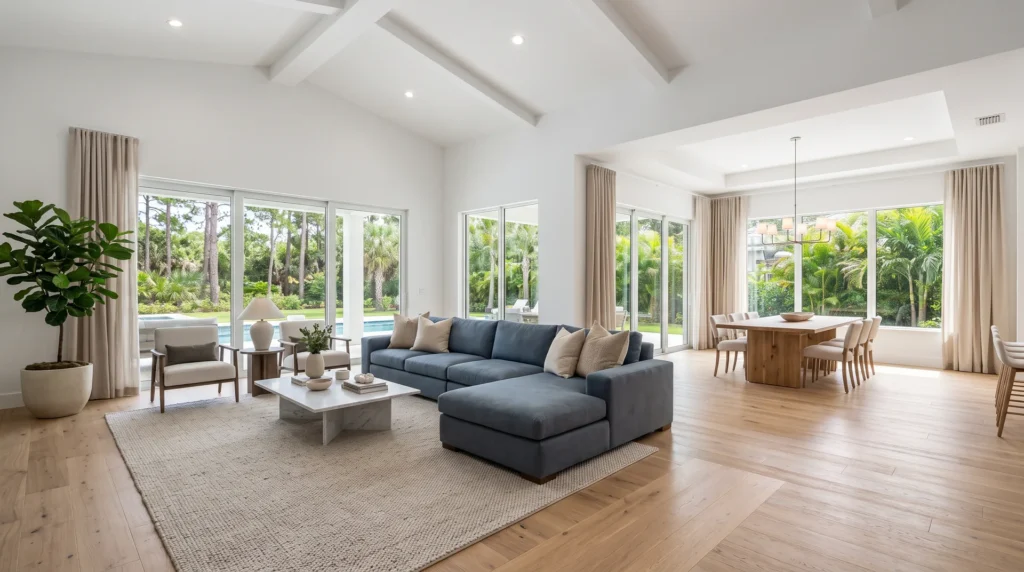
Whole-Home Flooring Before &


Tile Flooring Questions
What drives tile floor installation cost the most?
The biggest factors are square footage, the tile you choose and the labor that large formats require. Tearing out old tile, grinding and leveling the slab, membranes, baseboards, transitions and moving furniture all add to the total fast. A proper whole-home quote breaks out every one of those lines so you can line up bids side by side and avoid change orders.
Which is better in a Florida home, porcelain or LVP?
Porcelain wears better, stands up to water and sun, and lasts for decades. LVP feels warmer, is quieter and goes in faster, a plus in condos with sound rules. A lot of owners put porcelain in the living areas and wet rooms and use LVP in upstairs bedrooms.
How long does it take to tile a whole home?
That comes down to square footage, demolition and leveling. On a typical one-story house, the flooring work often runs a couple of weeks once the materials arrive, and longer when the old tile is stuck down hard or the slab needs a lot of leveling. We set your schedule after the scan and the slab inspection.
We scan the home, inspect the slab and render the tile you picked before we quote one fixed price.
Why Homeowners Choose Cutting Edge
How a whole-home floor turns out depends on the slab below it and the layout above it. Cutting Edge Kitchen & Bath is a licensed Florida general contractor serving Naples and Marco Island, with more than 500 Southwest Florida remodels and nine Best of Houzz awards behind us. The free LiDAR scan captures accurate measurements of each room, the photo-real 3D render shows you tile and plank direction before anything is ordered, and samples at our 4,000-square-foot Bonita Springs showroom can be compared in real light. One fixed-price contract covers it, and our own crews handle demolition, prep and installation.