
Steam Shower Installation
How It Is Built Right
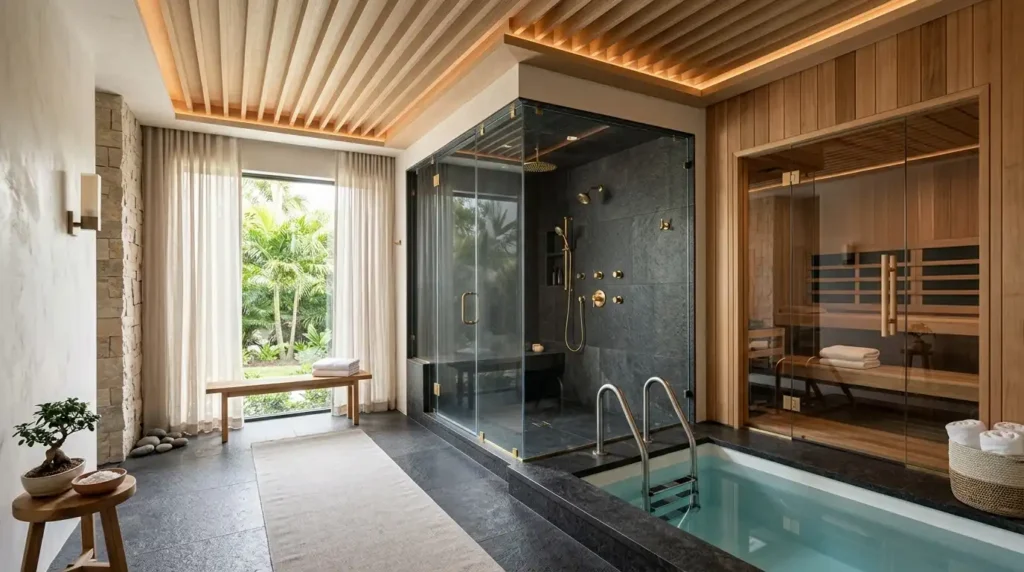
A steam shower is just a standard shower that has been sealed from floor to ceiling and connected to a steam generator. Installing one requires four things: an enclosure that holds vapor, with steam-rated waterproofing behind the tile; a sloped ceiling that lets condensation run off rather than drip; a glass door that seals; and a generator sized for the room's volume, wired on a dedicated circuit of its own. Most get built within an existing primary shower during a bathroom remodel, which is where nearly all the planning and cost sits.
What Goes Into a Steam Shower Install?
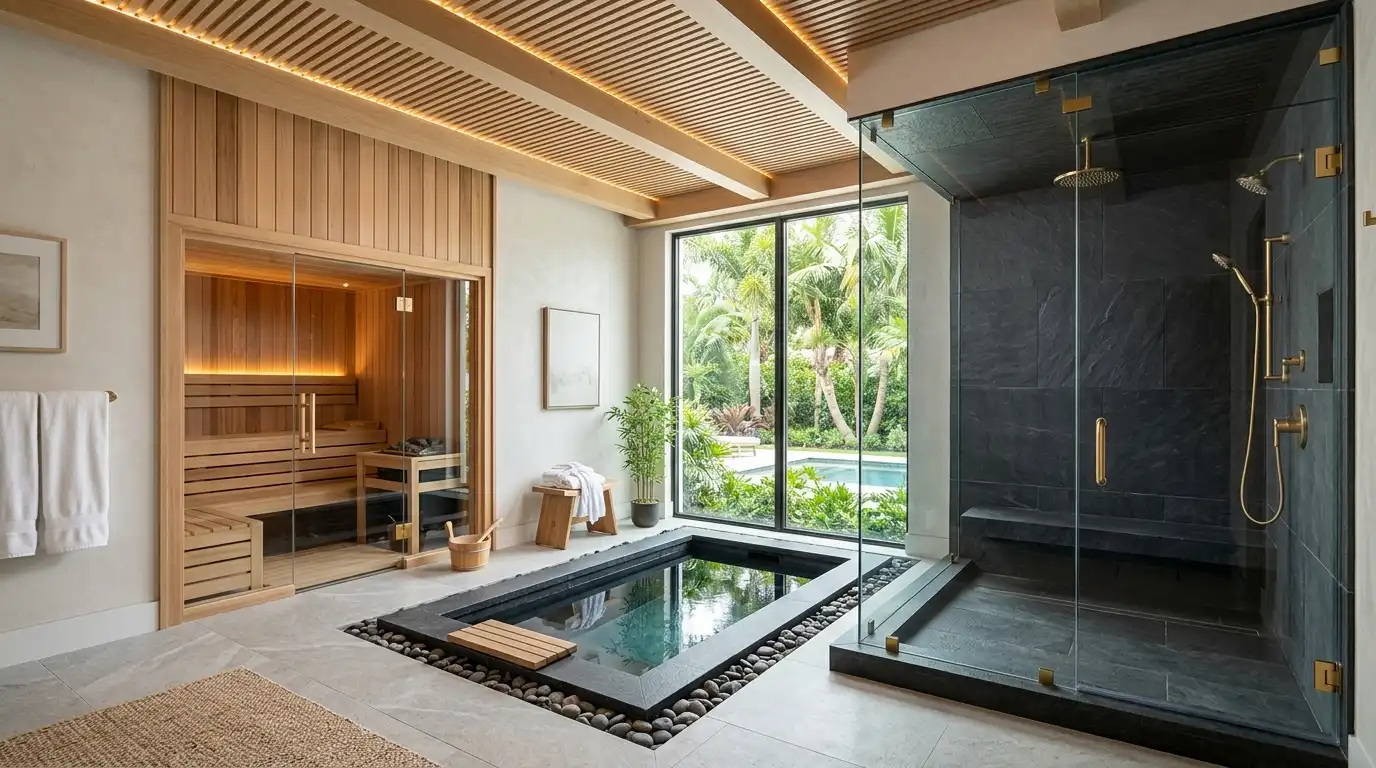
Everything revolves around the generator. Manufacturers size it to the enclosure's cubic footage, then bump it up for stone or porcelain walls, which soak up more heat than acrylic, and for high ceilings or exterior walls. Too small a unit runs nonstop without ever filling the room; too large a unit cycles hard. It is typically housed in a linen closet, vanity cabinet or attic inside the manufacturer's distance limit, and it needs a cold-water supply, a drain or a route for the safety relief, and a dedicated circuit, usually 240 volts.
Within the shower, a continuous vapor-retarding membrane goes over the walls and ceiling before any tile, and every seam, niche and valve opening is sealed. The ceiling generally stays at roughly eight feet or under and slopes toward one wall, while the glass goes all the way up with a transom or door seals. The steam head is mounted low and away from the bench; a control panel sits inside, with a remote by the entry so you can preheat the room before stepping in. Extras like aromatherapy, lighting and audio get wired during the same phase.
| Component | What it does | Planning note |
|---|---|---|
| Steam generator | Boils water and delivers vapor to the shower | Sized by cubic footage, then bumped up for stone or tile walls and taller ceilings |
| Dedicated circuit | Powers the generator | Usually 240V; the generator's amperage sets the size |
| Vapor membrane | Keeps steam out of the walls and ceiling | Has to be steam-rated and continuous, ceiling included |
| Sloped ceiling | Directs condensation down the walls | Kept low so the room heats fast |
| Enclosure glass | Keeps the steam in | Full height with a sealed door, often with an operable transom |
| Controls and steam head | Sets time and temperature, releases vapor | Steam head mounted low and away from seating |
Look over our home spa packages in Good, Better and Best tiers, from a basic steam conversion up to a full spa suite.
What Changes in a Naples Steam Shower?
For much of the year the humidity here is already high, so a steam shower leaking vapor into the wall cavity or the attic will start growing mold quickly. For that reason we build the enclosure as a sealed box and add a timed exhaust fan to clear the room after each use. Most homes in Southwest Florida are block on slab, which helps: on exterior walls the membrane goes right over the block, and sloping and waterproofing the floor is simple with no wood framing beneath it.
Adding steam to a bathroom remodel brings in the generator, more electrical work, glass that runs full height and stricter waterproofing, so expect a bigger budget than a regular walk-in shower would need. Our home spa packages begin at $18,500. In Naples and on Marco Island, condo owners will need the association's approval since the work touches plumbing, electrical and venting, and permits for it are required by the city or county. If you live here part of the year, Wi-Fi controls let you run a brief cycle and check that everything works before you arrive.
Where the Generator Goes in a Flood Zone or Ground-Floor Bath
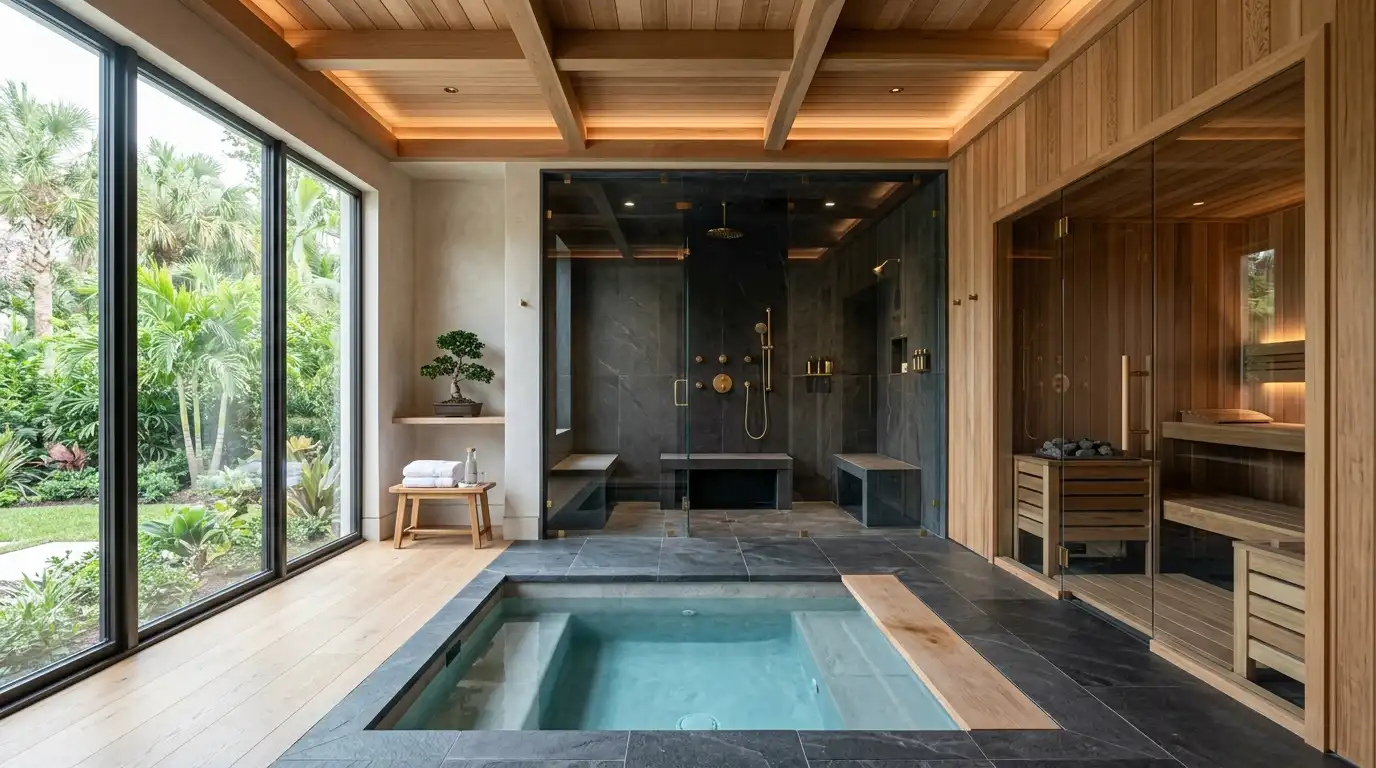
Most steam guidance stops at the bathroom door, but in Naples the lot and the building decide where the generator can sit. The Florida Division of Emergency Management’s summary of the 8th edition residential code flood provisions says equipment must be at or above the required elevation unless it is designed under ASCE 24 (section R322.1.6). A generator tucked into a ground-floor vanity or closet in a mapped flood zone therefore needs a conversation with the building department before the cabinet is ordered. It does not apply to a unit on an upper floor of a tower, where the question becomes shaft and riser access.
What goes behind the tile matters in the same zones. FEMA Technical Bulletin 2, revised January 22, 2025, says materials below the base flood elevation in a special flood hazard area must withstand direct, prolonged contact with floodwater, defined as at least 72 hours. It lists cement board, mortar-set ceramic or porcelain tile and non-paper-faced gypsum as acceptable, and paper-faced gypsum, tile set with organic adhesive and built-in wood or particleboard cabinets as unacceptable. A cement-board steam enclosure and a particleboard vanity beside it land on opposite sides of that list.
The City of Naples floodplain page says almost all permitted development gets floodplain review and that a substantial-improvement estimate must include every cost of fully repairing or improving the structure. A steam suite built alongside a new kitchen and flooring adds to that total. Because the bulletin and the code summaries come from secondary postings, confirm the current provisions with the building department that covers your address.
Condo Approval, Insurance and Association Rules
Steam work seldom stays inside one unit’s walls. Under section 718.113(2)(a), if a declaration does not say how material alterations or substantial additions to common elements are approved, 75 percent of the total voting interests must approve them before work begins, and subsection (3) prohibits a unit owner from doing anything that would adversely affect the safety or soundness of the common elements. A vent routed through a shared wall, a drain tied into a building riser or a new circuit pulled from a common panel can all raise that question, so get the board’s answer in writing first. One Marco Island association’s renovation form, for The Sands of Marco, asks owners to submit a modification request, has contractors file a license, insurance certificates and an indemnification agreement, and has the property manager inspect opened walls with the contractor before drywall goes back.
Insurance is a separate layer. Section 718.111(11)(f), as summarized by the Becker law firm, excludes from the association’s policy such unit items as floor, wall and ceiling coverings, electrical fixtures, appliances, water heaters and built-in cabinets and countertops, which leaves them to the owner’s HO-6 policy. A steam generator is not named on that list, so ask both the association’s manager and your own insurance agent where it falls.
Building age varies widely. A local brokerage’s Pelican Bay high-rise timeline runs from Dorchester in 1981, called the first high-rise, to Mystique in 2019, the last one built there. Rules, plumbing and electrical capacity differ across four decades, so request the declaration, the rules and the contractor requirements for your building before you finalize a design. On Marco Island, the City’s multi-family remodel application asks for notarized owner and contractor affidavits, a floor plan of the building showing the work area and any floor penetrations, and a separate permit for each unit with its own folio number.
Permits, Inspections and Work Hours by Jurisdiction
Plumbing and electrical work for steam is permitted work, and the office depends on the address. According to the Jaspector directory, the City of Naples Building Department at 295 Riverside Circle covers addresses inside city limits and Collier County Building Plan Review and Inspection at 2800 N. Horseshoe Drive covers unincorporated Collier, where the same directory says an inspection requested before 4:30 p.m. can happen the next day. Marco Island has its own Building Services department. Collier’s published list of work exempt from permits describes replacing existing items such as faucets, fixtures and switches, and a new dedicated circuit with a new generator is a different kind of job, so ask before assuming any exemption applies.
Marco Island’s plumbing application, version 2023, says plans are required unless the work is like-for-like, that drawings show a riser diagram, vent sizes and traps, and that the permit fee is quadrupled when work starts without a permit. Treat those as pointers to what the reviewer will want and confirm the current form with the city.
Demolition for a steam conversion is noisy. Naples code section 22-37, as posted by the city, limits demolition to Monday through Friday, 8 a.m. to 6 p.m., and residential construction to 7 a.m. to 6 p.m. Monday through Saturday, and bars work on six listed holidays. Condo buildings often set tighter hours of their own, so ask the manager for the schedule before booking the crew.
Humidity, Leaks and Months When the Home Is Closed
Moisture is the failure mode that matters in Southwest Florida. The EPA’s guide to mold and moisture says water-damaged areas should be dried within 24 to 48 hours and indoor relative humidity kept below 60 percent, ideally between 30 and 50 percent, and that condensation appearing on walls or windows should be dried quickly. A steam shower deliberately pushes humidity far above that range inside the enclosure, which is why the room needs a plan for how fast it dries afterward.
Seasonal owners need a second plan. The Atlantic hurricane season runs June 1 through November 30, according to Fox Weather, so if you close the home for part of it, ask your contractor how the system is shut down and drained for an absence, who checks it, and what the air conditioning setting should be. If a leak does spread, Florida’s mold statutes treat assessment or remediation covering more than 10 square feet as a licensed activity, with an exemption for residential owners working on their own property, per the chapter text as summarized online, so call a licensed professional for anything large. The EPA guide says an area smaller than about 10 square feet can usually be cleaned by the owner. For related glass details, see our frameless shower door guide.
Steam Shower Installation Before &


Steam Shower Questions
What size steam generator do I need?
Start by working out the enclosure volume, multiplying length, width and height in feet. From there, most manufacturers use their own sizing charts to add capacity for stone or tile walls, exterior walls and ceilings taller than eight feet. We size your generator from LiDAR measurements of the actual shower, so the figure comes from real dimensions instead of a guess.
Can every shower be turned into a steam shower?
Many can, provided the walls can be opened up for a steam-rated membrane, the glass can be carried to the ceiling and the generator can sit within the distance limit the manufacturer allows. An open-topped shower, one with a curtain or one under a skylight usually has to be reworked first. Walking through the space answers it fast.
Do steam showers need a dedicated electrical circuit?
Yes. Residential steam generators need their own circuit, and most models call for 240 volts. How big the breaker is depends on the generator's rating. Have a licensed electrician handle it under a permit; that is one reason steam showers usually get planned inside a larger bath remodel.
Do I need condo association approval for a steam shower in Naples?
Usually you need at least the association’s written approval, because the work touches plumbing, electrical and venting. If the declaration is silent on material alterations to common elements, Florida section 718.113(2)(a) requires 75 percent of voting interests. Ask for the declaration and the contractor rules first.
Can a steam generator go in a ground-floor closet in a flood zone?
Possibly, but the 8th edition Florida Building Code flood provisions, as summarized by the state, require equipment at or above the required elevation unless it is designed under ASCE 24. Ask the building department before you choose a location.
What if a steam shower leaks and mold spreads?
The EPA advises drying water-damaged areas within 24 to 48 hours. Florida treats mold assessment or remediation over 10 square feet as a licensed activity, with an owner exemption on your own property, so call a licensed professional for anything large.
We measure your shower, work out the generator size and render the enclosure before giving you one fixed price.
More in Steam Shower & Home Sauna Installation
Why Naples Owners Pick Cutting Edge
A steam shower is mostly work you never see, and in Florida that unseen work is the first thing to fail. With more than 500 remodels across Southwest Florida and nine Best of Houzz awards, Cutting Edge Kitchen & Bath, a licensed Florida general contractor, puts the membrane, generator sizing and venting in the hands of crews who have built in this climate for years. Come see steam fixtures and finishes in our 4,000-square-foot Bonita Springs showroom, then get a free LiDAR scan, a photo-real 3D rendering and one fixed-price contract, built by our own crews.